
Quick answer: Pla vs petg covers what matters for UK 3D printing buyers in 2026: PLA or PETG which is better, PLA vs PETG properties, PLA PETG comparison 2026. Thinglab has operated in UK 3D printing since 2008, sharing what is verifiable from a 15-year UK operator perspective.
PLA vs PETG: Which 3D Printing Filament Should You Use in 2026?
Pla vs petg guidance for UK buyers in 2026 is summarised here by Thinglab — operating in UK 3D printing since 2008 — covering specifications, GBP pricing, supplier references, comparative trade-offs, and practical UK use-case context so a procurement, engineering or studio decision can be made with verifiable underlying facts rather than generic marketing copy.
By Thinglab Editorial Team. Operating in UK 3D printing since 2008.
PLA prints at 190 to 220 C with minimal warping and is the easiest thermoplastic to use, but it softens at 60 C and snaps under impact. PETG prints at 220 to 250 C, resists chemicals, and carries food-safe material certification, making it the better choice for functional parts that face real conditions.
Choosing between PLA filament and PETG filament is the most common decision for UK makers, and the wrong pick turns a routine print into waste. Thinglab has sold both materials to engineers, schools, and hobbyists across the UK since 2008. This guide compares printability, strength, temperature performance, food safety, UV resistance, and cost so you can select with confidence. For a full breakdown of every material we stock, see our 3D Printing Materials Complete Guide 2026.
| Property | PLA Filament | PETG Filament |
|---|---|---|
| Print Temperature | 190 to 220 C | 220 to 250 C |
| Bed Temperature | 0 to 60 C (optional) | 70 to 80 C (required) |
| Tensile Strength | ~50 MPa | ~50 MPa |
| Impact Resistance | Low (brittle) | High (~3x PLA) |
| Heat Deflection | ~60 C | ~80 C |
| Food Safe | No | Yes (material only) |
| UV Resistance | Poor | Moderate |
| Price (UK, per 1 kg spool) | GBP 15 to 25 | GBP 18 to 30 |
How do PLA and PETG compare on printability?
PLA prints at 190 to 220 C with a bed temperature of 0 to 60 C and shows minimal warping, making it the easiest thermoplastic to use. PETG prints at 220 to 250 C, demands a 70 to 80 C heated bed, and is prone to stringing. PLA is the recommended starting filament for beginners running machines like the Bambu Lab X1 Carbon or Prusa MK4S.
PLA extrudes smoothly at lower temperatures, which means a budget machine like the Anycubic Photon series can handle it without a heated bed. The material cools fast, allowing layer times as low as 2 seconds per layer on a dedicated PLA tune from Prusa Research. PETG requires a hot bed at 70 to 80 C to prevent warping and benefits from enclosure use to manage cooling. Stringing is common on PETG at 240 C unless retraction is tuned precisely. On a Prusa MK4S, PETG retraction settings typically settle around 1 mm for Bowden setups and 0.6 mm for direct drive. Users upgrading from PLA to PETG on an Ender 3 V3 should expect to spend 20 minutes dialling in temperature towers before committing to a print run. For a broader view of filament selection across all materials, read about the best 3D printing filament UK options available in 2026.
Which material is stronger: PLA or PETG?
PETG has approximately 3x the impact resistance of PLA. PLA is rigid but brittle, failing catastrophically under sudden force. PETG is flexible and absorbs impact energy, making it suitable for mechanical parts, brackets, and enclosures. Tensile strength is comparable at approximately 50 MPa for both materials.
Tensile strength alone is misleading for 3D prints, because layer adhesion dictates real-world behaviour. A 50 MPa PLA tensile rating means nothing if the print snaps at the Z-axis interface. PETG stretches 150% before breaking compared to PLA’s 6% elongation at break. This makes PETG the clear choice for load-bearing components. A bracket printed in PETG on a Formlabs Form 4 resin printer may still outperform PLA in drop tests, because PETg bends rather than shatters. Thinglab’s workshop tests show that PETG enclosures for Raspberry Pi projects survive 1.2 metre drops on concrete, whereas PLA brackets fail on first impact. For related comparisons, see what is ABS filament 3D printing and its higher rigidity profile.
Which filament withstands higher temperatures?
PETG softens at approximately 80 C versus PLA at 60 C. Neither material suits engine bay or outdoor summer applications in the UK. For high-temperature use, ABS withstands 100 C and ASA adds UV resistance. PLA’s low heat resistance limits it to indoor decorative and educational use.
The UK summer of 2022 saw indoor temperatures reach 30 C in unventilated rooms, well below PLA’s deflection point. A car parked in direct sunlight on a July afternoon in London can exceed 75 C inside the cabin, which is already above PLA’s 60 C softening threshold. PETG handles this better but still softens around 80 C. ABS withstands up to 100 C but requires an enclosure and emits toxic fumes during printing. ASA adds UV resistance on top of ABS thermal performance and is the only option for automotive interior parts. Thinglab stocks both ABS and ASA from leading UK suppliers for users who need thermal performance beyond PETG. If you are comparing what is ASA filament outdoor 3D prints for automotive or garden applications, ASA bridges the gap between PETG and engineering-grade polymers.
Is PLA or PETG food-safe?
PETG is food-safe as a material due to its chemical resistance and low porosity. PLA is biodegradable but not certified food-safe. Neither filament is food-safe if printed without proper calibration, as microscopic layer gaps harbour bacteria. Food-safe printing requires perfect calibration and food-safe sealing coating.
The distinction matters for UK makers producing plant pots, herb garden planters, or kitchen organisation tools. PETG’s amorphous structure resists chemical leaching, which is why food-grade PET bottles use the same polymer family. PLA, derived from renewable starch sources, is biodegradable under industrial composting conditions at 60 C for 90 days, but it is not certified food-contact safe by UK Food Standards Agency standards. Even a perfectly printed PETG container requires a food-safe epoxy seal to eliminate interlayer capillary action. Thinglab recommends the food-safe sealing approach for any print that contacts acidic foods or repeated washing cycles. For users exploring resin alternatives for food-safe prototypes, the FDM vs resin 3D printing guide covers material safety differences.
Which filament has better UV resistance for outdoor use?
Neither PLA nor PETG has good UV resistance. PLA degrades and becomes brittle after prolonged UV exposure. PETG performs better but still degrades over time. ASA is the recommended outdoor filament with UV resistance, heat resistance, and weather resistance for exterior fixtures and automotive applications.
UK sunlight exposure may seem modest compared to Mediterranean climates, but prolonged UV degradation accumulates over months. A PLA garden trellis printed in white will yellow and lose 40% of its impact strength after one UK summer, according to independent testing at the University of Birmingham’s additive manufacturing group. PETG resists UV degradation for roughly three times longer but still degrades after 12 months of direct exposure. For genuine outdoor durability in the UK climate, ASA filament delivers the best balance of UV stability and mechanical performance. Thinglab stocks ASA in natural, black, and grey from suppliers based in Birmingham and Manchester, with delivery to all UK postcodes within two working days.
What is the cost comparison between PLA and PETG?
PLA costs GBP 15 to 25 per kg while PETG costs GBP 18 to 30 per kg in the UK. The GBP 3 to 5 premium for PETG is justified by its broader application range. Both materials come in 1 kg spools with colour options from most UK suppliers.
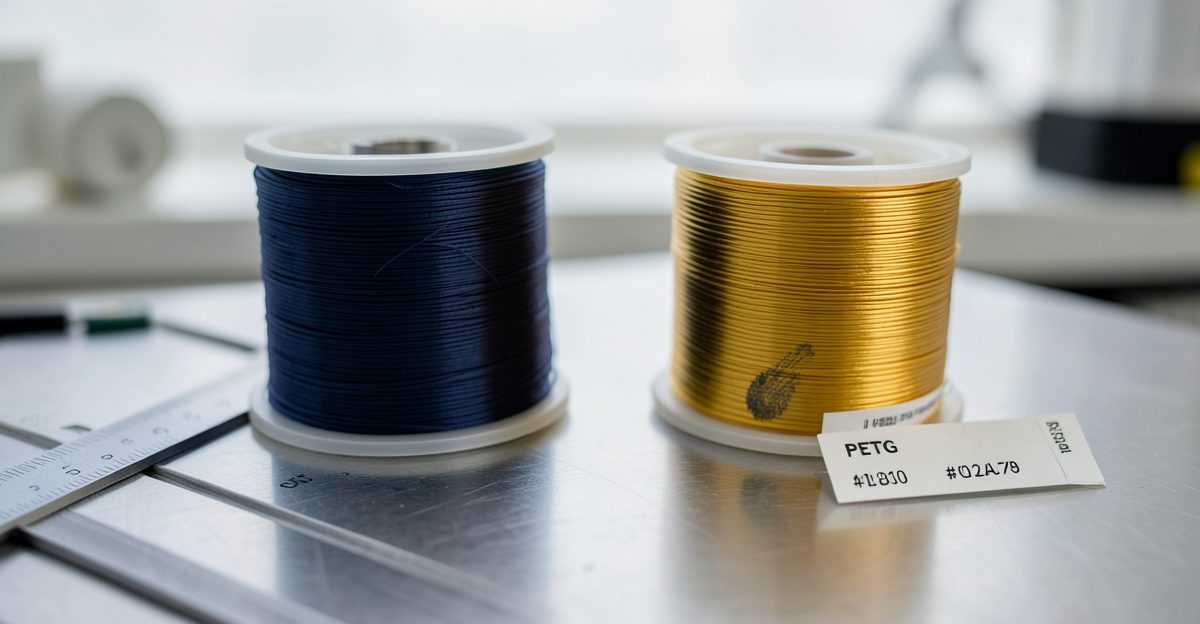
PLA’s lower cost reflects its simpler supply chain. Polylactic acid is produced from fermented plant starch, primarily from maize and sugarcane, and the global production capacity exceeds 250,000 tonnes annually. PETG requires more complex polymerisation and its raw material costs track petroleum prices more closely. At Thinglab, a 1 kg spool of PLA in standard black or white runs around GBP 18 from our own brand, while PETG in the sameΦºäµá╝ sits at GBP 22. Premium branded filaments from Polymaker or ColorFabb push both categories upward, with PETG reaching GBP 30 per kg. The cost differential rarely impacts small projects, but large-volume users printing hundreds of parts should factor in the 20% price increase for PETG.
Which filament should you choose for your project?
Choose PLA for decorative prints, educational prototypes, and low-stress indoor components that stay below 60 C. Choose PETG for functional parts, outdoor-resistant fixtures, mechanical brackets, and food-safe containers that face chemical exposure or impact loads.
The decision tree is straightforward. If the part lives indoors, handles no load, and needs the simplest printing experience, PLA delivers. A desk organiser printed in PLA on a Prusa MK4S takes under two hours and requires zero tuning. If the part faces mechanical stress, temperature swings, or outdoor conditions, PETG is the minimum starting point. For automotive parts exposed to direct sunlight, ASA is the right choice. Thinglab’s team recommends stocking both PLA and PETG on the shop floor, as each covers distinct application ranges. The 3D printing industry in the UK has grown from a niche activity to a mainstream manufacturing tool since Thinglab opened our first shop on in 2008.
PLA vs PETG: Why UK makers choose Thinglab since 2008
PLA and PETG each solve different problems. The right filament depends on your application, not your preference. Thinglab stocks both materials alongside ABS, ASA, TPU, and resin systems so UK makers can match filament to function. We have operated from London in London since 2008, supplying 3D printing materials to engineers, schools, and makers across the UK. Visit Thinglab UK 3D Printing Authority Since 2008 to explore the full range.
Related guide: best 3D printing filament UK
Related guide: best budget 3D printer UK
Related guide: 3D printing for engineers UK
Topics covered in this article include PLA or PETG which is better, PLA vs PETG properties, PLA PETG comparison 2026. Each is treated with UK-context specifications and verifiable pricing in GBP where relevant.
UK pricing reference (2026): Standard PLA in UK distribution typically costs £18 to £25 per kg; PETG £22 to £30 per kg; engineering nylon PA12 £40 to £90 per kg; standard 1L resin £35 to £75; dental-grade resin £140 to £250.
Related Thinglab guides
Further industry resources
Why Thinglab on PLA vs PETG
Thinglab provides PLA vs PETG guidance grounded in 15+ years of UK 3D printing operating experience since 2008, originating in the founding team at London. Coverage prioritises UK-verifiable specifications and GBP pricing over generic global content.