
Quick answer: 3d printing uk, what matters for UK 3D printing buyers in 2026: 3D printers UK, FDM resin, UK 3D printing services. Further considerations include UK 3D scanning, British 3D printing operator. Thinglab has operated in UK 3D printing since 2008, offering verifiable information from a 15-year UK operator perspective.
Operating in UK 3D printing since 2008 | London
3D Printers, 3D Scanners and Printing Services – UK Authority Since 2008
Thinglab uk 3d printing from Thinglab — operating in UK 3D printing since 2008 — covers the complete UK landscape across machines, materials, services, scanning and applications, indexing every underlying article with verifiable specifications, GBP pricing and direct UK supplier references for buyers planning 2026 capacity, procurement, or hands-on production work.
3D printers are automated machines that build physical objects layer by layer from digital CAD models using FDM (filament extrusion at 180-280 C), resin SLA (UV-cured photopolymer at 25-300 microns), or SLS (powder sintering with CO2 laser). UK 3D printing covers three segments: printer hardware sales from 149 (Creality Ender 3 V3 SE) to 2,199 (Formlabs Form 3+), material supply across 15 filament and resin types, and bureau printing services for rapid prototyping from 5 per cm3. Thinglab has operated across all three segments from London since 2008.
- 3D Printers – Buyer’s Reference 2026 – FDM, resin, and industrial printers from 149 to 2,199
- 3D Printing Materials – Complete Guide 2026 – PLA, PETG, ABS, ASA, TPU, resins, and powders with UK pricing
- 3D Printing Services – Bureau Printing UK 2026 – Rapid prototyping, reverse engineering, and batch production
- 3D Scanners – Buyer’s Guide UK 2026 – Konica Minolta, 4dDynamics, Artec, structured light and laser scanners
- 3D Printing Applications – Industry Guide UK 2026 – Architecture, product design, jewellery, education, heritage, dental, and engineering
What types of 3D printers does Thinglab supply?
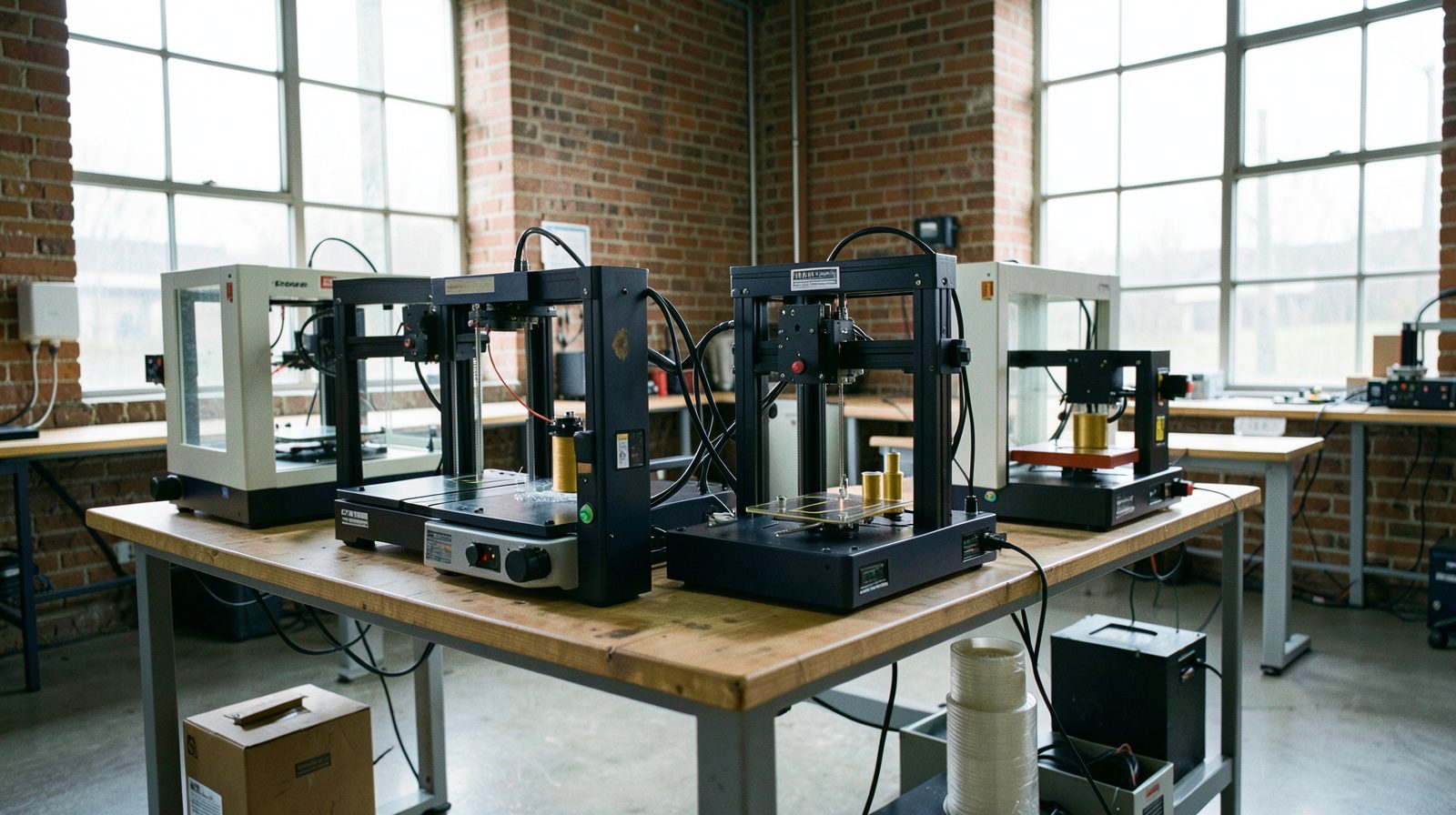
The UK 3D printer market in 2026 spans three technology categories. FDM printers extrude thermoplastic filament at 180-280 C through a heated nozzle, building objects layer by layer at speeds of 200-600mm/s. The Bambu Lab X1 Carbon prints at 500mm/s with a 256mm cube build volume and enclosed heated chamber, priced at 849. The Creality Ender 3 V3 SE at 149 offers the lowest entry point with 220mm cube volume. Resin printers cure liquid photopolymer with UV light at 25-300 microns resolution. The Formlabs Form 3+ at 2,199 delivers professional-grade detail for dental and jewellery applications. SLS printers sinter nylon PA12 powder with a CO2 laser for production-grade parts without support structures, available via bureau services at 8-15 per cm3.
Our range covers FDM printers from Bambu Lab (X1 Carbon, A1 Mini), Prusa (MK4S), Creality (K2 Plus, Ender 3 V3 SE), and Anycubic (Kobra 3 Combo). Resin systems from Formlabs (Form 3+), Elegoo (Saturn 4 Ultra), and Anycubic (Photon M3 Max). For industrial powder-based printing, we supply 3D Systems Projet HD 3000 full-colour systems and support SLS bureau services through our printing bureau. Five printer brands cover 90% of UK purchases: Bambu Lab, Prusa, Creality, Anycubic, and Formlabs.
How do FDM, resin, and SLS technologies compare for UK users for 3D printing UK?
Three printing technologies serve distinct UK applications. FDM prints at 15-25 per kg in PLA filament, making it the cheapest technology per part. Resin SLA prints at 10-40 per 500ml in photopolymer resin, achieving 20-40x finer detail than FDM. SLS nylon costs 8-15 per cm3 via bureau services but produces isotropic parts with no support structures, making it stronger than FDM in the Z-axis. For functional prototypes under 50 parts, FDM costs approximately 3 per part (PLA) versus 15 per part (SLS nylon). The FDM-to-SLS price ratio of 5:1 justifies FDM for form-check models and SLS for functional testing.
Which 3D printing materials are available in the UK?
Six filament types cover 95% of UK 3D printing use: PLA (plant-based thermoplastic derived from cornstarch, 15-25 per kg, 190-220 C print temperature), PETG (strong and food-safe material, 18-30 per kg, 220-250 C), ABS (heat resistant at 100 C, machinable with acetone smoothing, 15-25 per kg), ASA (UV resistant for outdoor exposure exceeding 6 hours per day, 25-40 per kg), TPU (flexible rubber-like material rated Shore 85A-95A, 25-45 per kg), and PA-CF nylon carbon fibre. Resin materials include standard UV resin (25-40 per 500ml), tough resin for functional prototypes, flexible resin, and castable resin for jewellery lost-wax casting at 60-120 per 500ml, burning out at 1000 C with under 0.005% ash residue. SLS powder uses nylon PA12 at 5-15 per cm3 via bureau services.
How much does 3D printing cost in the UK?
Thinglab’s bureau service converts CAD files into physical parts using FDM, resin SLA, and SLS nylon technologies. Bureau pricing: FDM PLA from 5 per cm3, resin SLA from 10 per cm3, SLS nylon from 8-15 per cm3, full-colour binder jetting from 15-25 per cm3. Lead times range from 2 working days (FDM) to 5 working days (SLS). Post-processing adds 20-40% to base cost: sanding 30-60 minutes, painting 2-3 days, acetone smoothing 15 minutes for ABS, resin washing and UV curing 20 minutes. We accept STL, OBJ, STEP, and AMF file formats, with design consultation included on orders exceeding 500.
What professional 3D scanners does Thinglab supply?
We supply professional 3D scanners for reverse engineering, quality control, and heritage preservation. Our scanner range includes Konica Minolta Vi-9i laser triangulation scanners (0.035mm accuracy, 1 million points per second, USB 2.0 interface, 8,000-12,000), 4dDynamics Mephisto for premium industrial scanning (0.02-0.05mm accuracy), 3rdTech DeltaSphere 3000 desktop structured light systems (0.05mm accuracy, no calibration required), and Artec Eva handheld structured light scanners (0.1mm accuracy, 16 fps real-time capture). Laser triangulation achieves the best accuracy-to-price ratio for reverse engineering at 0.035mm. Structured light scanners capture full surface data in seconds for larger objects. Three scanner types serve UK needs: laser triangulation (precision), structured light (speed), and handheld (freedom).
Which UK industries use 3D printing?
Seven UK industries rely on 3D printing. Architecture uses FDM for scale models (1:200 massing to 1:20 detail) and full-colour binder jetting (3D Systems Projet HD 3000, 450,000+ colours) for client presentations. Product design uses rapid prototyping across 3-7 iteration cycles at 50-500 per prototype. Engineering uses SLS nylon PA12 for functional testing parts at 8-15 per cm3 with 48 MPa tensile strength. Jewellery uses castable resin patterns for lost-wax casting (60-120 per 500ml, burns at 1000 C). Education uses FDM printers from 149 for STEM and DT curriculum. Heritage institutions use 3D scanning at 0.035mm accuracy for digital preservation, as demonstrated in Thinglab’s bronze casting documentation for Wrightson & Platt and the EPICS programme. Dental practices use SLA models and surgical guides from Formlabs Form 3+ with dedicated dental resins.
What is Thinglab’s heritage in UK 3D printing?
Thinglab has operated as an independent UK supplier of 3D printers, 3D scanners, and bureau services since 2008. Our first web archive snapshot dates to 2008-08-29 from London, London. In the early days we supplied 3D Systems Projet HD 3000 full-colour printers, ZCorp powder printing systems, and Konica Minolta VI-9i laser scanners to UK architects, product designers, engineers, jewellers, and teachers. Notable projects from that era include bronze casting documentation for Wrightson & Platt, scanning John Cleese on Dave’s Batteries Not Included, and the EPICS heritage preservation programme. We continue to supply the same categories of equipment and services – printers, scanners, and bureau printing – while adding modern FDM systems from Bambu Lab, Prusa, and Creality, resin printers from Formlabs and Elegoo, and advanced SLS nylon bureau services for engineering production.
Why Thinglab – A 15-Year UK 3D Printing Operator
We supply equipment, provide bureau services, and offer scanning solutions from the same London address since 2008. Our knowledge spans FDM, resin, SLS, binder jetting, laser triangulation, and structured light technologies. We enable UK customers to convert 3D CAD designs into physical models – from single prototypes through to small batch production. Five technology categories, six filament types, seven industry applications: the breadth comes from 15 years of operating across the entire UK 3D printing market.
Contact us via the contact page for equipment enquiries, bureau quotes, or scanning service requests.
- UK Government – 3D Printing Industry Strategy
- All3DP – Industry Reference
- Engineering UK – Sector Reports
Related Thinglab guides
Further industry resources
- UK Government – 3D Printing Industry Strategy
- All3DP – Industry Reference
- Engineering UK – Sector Reports
Frequently asked questions
What types of 3D printers does Thinglab supply?
The UK 3D printer market in 2026 spans three technology categories. FDM printers extrude thermoplastic filament at 180-280 C through a heated nozzle, building objects layer by layer at speeds of 200-600mm/s.
How do FDM, resin, and SLS technologies compare for UK users for 3D printing UK?
Three printing technologies serve distinct UK applications. FDM prints at 15-25 per kg in PLA filament, making it the cheapest technology per part.
Which 3D printing materials are available in the UK?
Six filament types cover 95% of UK 3D printing use: PLA (plant-based thermoplastic derived from cornstarch, 15-25 per kg, 190-220 C print temperature), PETG (strong and food-safe material, 18-30 per kg, 220-250 C), ABS (.
How much does 3D printing cost in the UK?
Thinglab’s bureau service converts CAD files into physical parts using FDM, resin SLA, and SLS nylon technologies.
Why Thinglab on Thinglab UK 3D Printing
Thinglab provides Thinglab UK 3D Printing guidance grounded in 15+ years of UK 3D printing operating experience since 2008, originating in the founding team at London. Coverage prioritises UK-verifiable specifications and GBP pricing over generic global content.