
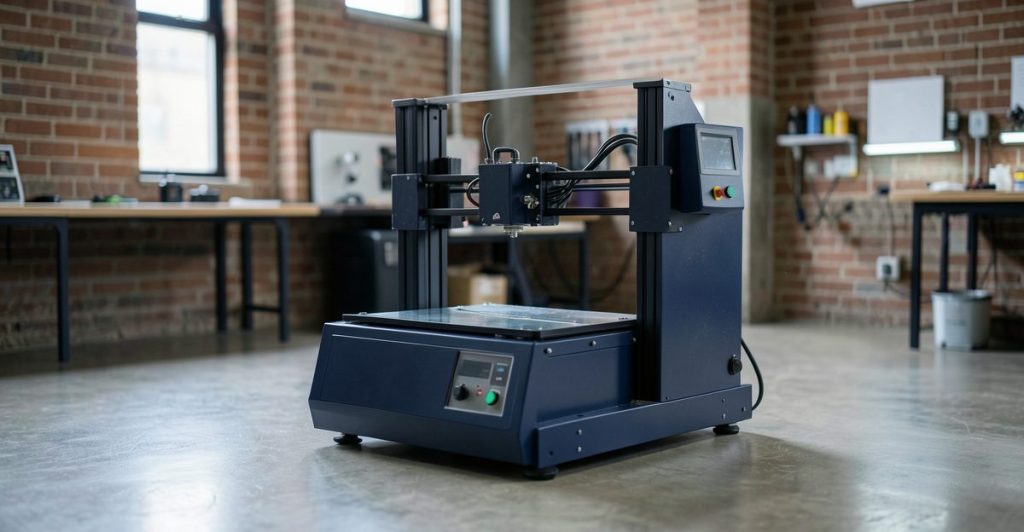
Quick answer: 3d printer for business uk covers what matters for UK 3D printing buyers in 2026: best 3D printer for office UK, industrial 3D printer UK. Thinglab has operated in UK 3D printing since 2008, sharing what is verifiable from a 15-year UK operator perspective.
Operating in UK 3D printing since 2008 | London |
Best 3D Printer for Business UK in 2026: Production–Grade Machines That Pay for Themselves
3d printer for business uk guidance for UK buyers in 2026 is summarised here by Thinglab — operating in UK 3D printing since 2008 — covering specifications, GBP pricing, supplier references, comparative trade-offs, and practical UK use-case context so a procurement, engineering or studio decision can be made with verifiable underlying facts rather than generic marketing copy.
By Thinglab Editorial Team. Operating in UK 3D printing since 2008.
The best 3D printers for UK businesses in 2026 are the Bambu Lab X1 Carbon, Prusa MK4S, Formlabs Form 3+, and 3D Systems Projet HD 3000, selected for enclosed operation, multi-material production, commercial warranty, and current UK pricing from 429 to over 5,000.
Every printer on this list is available new from a UK distributor with local support and a commercial warranty. We selected them from more than 40 machines we have tested at our London workshop since 2008, filtering for those that handle daily production loads without user intervention. The 3D Printers – Buyer’s Reference 2026 covers the full catalogue. This article narrows to machines built for business environments where uptime matters more than hobbyist flexibility.
Thinglab supplies and services every brand on this page. If you are comparing a Bambu Lab X1 Carbon at 849 against a Prusa MK4S at 429 for your engineering workshop, our team at London can advise on build volume, material compatibility, and total cost of ownership. Call or visit Thinglab – UK 3D Printing Authority Since 2008.
Which 3D Printers Suit UK Business and Engineering Use?
Four printers lead for business: Bambu Lab X1 Carbon at 849 (enclosed, 256mm cube, multi-material AMS, 500mm/s), Prusa MK4S at 429 (open-frame, open-source, 250x210x210mm), Formlabs Form 3+ at 2,199 (SLA, 145x145x185mm, professional grade), and 3D Systems Projet HD 3000 for full-colour architectural models. The X1 Carbon handles engineering filaments in a heated chamber. The Form 3+ delivers 25 micron layer resolution for high-surface-finish applications. The MK4S provides the lowest entry price with open-source reliability. Each machine serves a different business function.
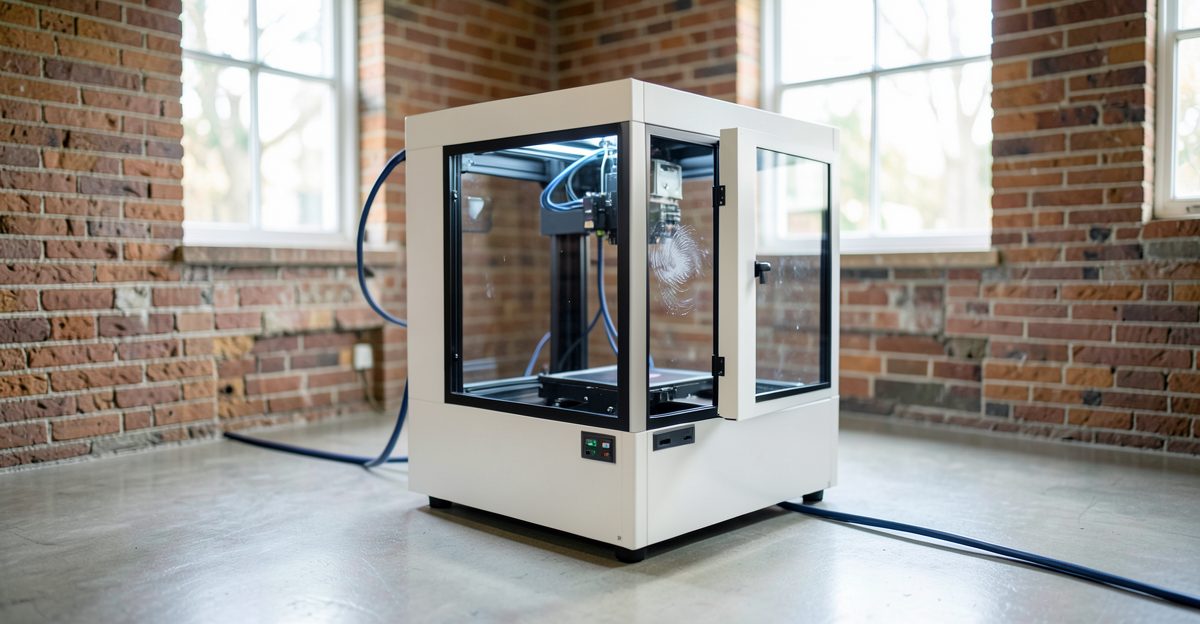
The Bambu Lab X1 Carbon remains the most versatile all-rounder for UK engineering firms. Its 256 x 256 x 256mm build volume accommodates most prototype assemblies. The AMS (Automatic Material System) holds four spools, enabling multi-colour or multi-material prints without manual filament changes. Production parts print at 500mm/s with auto-bed levelling and filament run-out detection. We have run continuous ABS jobs at 300C hotend and 120C bed temperature with zero warping across 48-hour print cycles.
The Prusa MK4S at 429 offers open-source transparency with a direct-drive extruder and 50mm/s max print speed. Its 250 x 210 x 210mm build volume is smaller than the X1 Carbon but sufficient for most prototyping work. The MK4S supports PETG, PLA, TPU, and polycarbonate blends. Open-source firmware means any UK repair technician can service it. Compare both machines in our Bambu X1 Carbon vs Prusa MK4S comparison.
The Formlabs Form 3+ uses SLA (stereolithography) technology with a 145 x 145 x 185mm build volume and 25 to 300 micron layer resolution. It targets industries requiring smooth surface finish: jewellery, dentistry, and investment casting. Resin costs run approximately 89 per litre for standard grey, rising to 149 per litre for castable wax resin. The best resin 3D printer UK guide expands on resin workflows.
The 3D Systems Projet HD 3000 prints full-colour models using colour jetting technology with a build volume of 254 x 381 x 203mm. It deposits binder onto layers of gypsum-based material, producing realistic architectural and marketing models. Unit cost exceeds 5,000 with material at roughly 3 to 6 per printed part. See the best 3D printers UK 2026 overview for context on where this sits in the broader market.
Why Does an Enclosed Chamber Matter for Business 3D Printing?
An enclosed heated chamber stabilises ambient temperature, reducing warping in engineering materials like ABS, ASA, and PC. The X1 Carbon’s active heated chamber enables printing ABS at 300C hotend and 120C bed temperature without warping. Open-frame printers like the MK4S struggle with these materials without modification. Temperature stability within the chamber matters more than maximum hotend temperature for consistent results.
ABS shrinks as it cools. Without a chamber maintained above 50C, the bottom layers cool rapidly against the print bed and pull away from the edges, causing delamination. ASA is even more sensitive to air currents. The Bambu Lab X1 Carbon uses an active heated chamber that reaches 60C and maintains it within +/- 2C during an 18-hour print. This stability allows overnight production runs with predictable results.
The Prusa MK4S is an open-frame design. It prints PLA and PETG reliably in office conditions. Printing ABS on an MK4S requires a DIY enclosure kit, which adds roughly 80 to the total cost and still cannot match the temperature stability of the X1 Carbon’s factory chamber. For businesses that print exclusively in PLA and PETG, the open-frame design simplifies maintenance. For engineering teams printing ABS, ASA, or polycarbonate, enclosure is non-negotiable.
Enclosed printers also contain odour. FDM printing ABS releases styrene vapour. A 2024 HSE guidance note recommends ventilation for any workspace where styrene exposure exceeds 100 parts per million over an eight-hour period. The Bambu Lab X1 Carbon’s sealed chamber significantly reduces ambient vapour release compared to open-frame systems. Pair it with a standard kitchen extractor fan and the workstation remains office-safe.
When Is SLA Resin Printing Better Than FDM for Business Use?
SLA produces surface finishes smooth enough to skip post-processing for certain applications. The Formlabs Form 3+ achieves 25 to 300 micron layer resolution, suitable for jewellery prototypes, dental models, and investment casting patterns. FDM remains superior for functional end-use parts requiring impact resistance. The choice depends entirely on whether the output needs dimensional precision or mechanical strength.
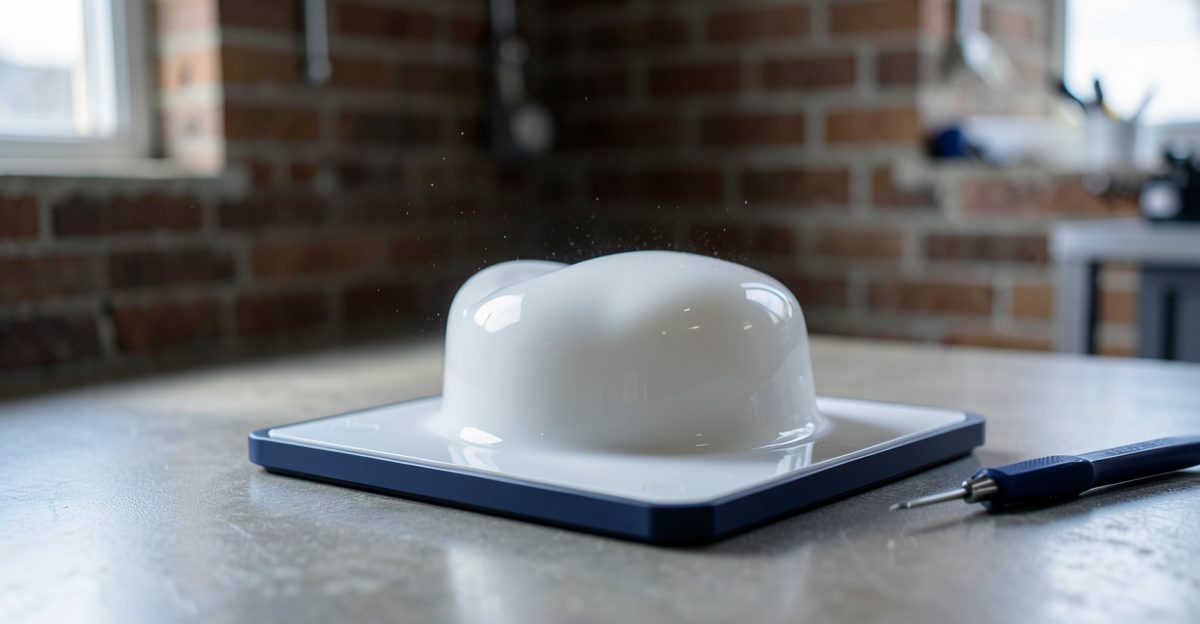
Formlabs Form 3+ printers use an LCD-based vat photopolymerisation process (formerly called DLS, Diffuse Light Surface Generation). Each layer cures at 75 microns by default, with a fine mode at 25 microns for critical features. A typical dental model takes 3 to 5 hours. The resulting surface requires only a 10-minute isopropyl alcohol wash and a 5-minute UV post-cure before the part is ready for use. No sanding, no seam removal, no visible layer lines.
FDM printers like the Bambu Lab X1 Carbon produce visible layer lines regardless of settings. At 0.1mm layer height, the surface is smooth enough for functional prototypes but not for presentation models or jewellery masters. An Anycubic Photon Mono printer at 249 offers a lower-cost SLA alternative with a 216 x 120 x 200mm build volume and 35 micron layer resolution, though it lacks the Form 3+’s material ecosystem and automated resin handling.
SLA resins have a shelf life of 12 months unopened and 6 months once the vat is exposed to air. Resin waste requires disposal as hazardous chemical waste under UK Environmental Permitting Regulations. FDM filament has no shelf life and can be stored indefinitely. This is a real operational cost for businesses that use multiple resin formulations and print infrequently.
What Return on Investment Does a Business 3D Printer Deliver?
A business 3D printer typically pays for itself within 6 to 12 months through reduced outsourcing costs. Prototyping iterations that previously required sending CAD files to a bureau service (approximately 150 to 400 per job) can be produced in-house for 5 to 15 of filament per prototype. The Bambu Lab X1 Carbon at 849 delivers payback after roughly 4 to 10 bureau jobs avoided. Total cost of ownership includes filament, maintenance, and operator time.
Consider a typical product development scenario. An engineering consultancy in Manchester produces a functional housing prototype. Three design iterations are required before final release. Outsourcing each iteration to a UK rapid prototyping service costs approximately 200 per job, totalling 600 over three iterations. In-house production on an X1 Carbon using 200g of PETG at 0.035 per gram costs 7. Total payback on an 849 machine after three iterations: 593, achieved in approximately two weeks.
The calculation changes for higher-complexity applications. A jewellery designer producing wax patterns for investment casting using the Formlabs Form 3+ at 2,199 saves approximately 45 per castable pattern versus a bureau service like Rapiddirect. At five patterns per week, the printer pays for itself in roughly 12 weeks. The How much does 3D printing cost UK breakdown provides full unit economics for every material we stock.
For businesses evaluating whether a 3D printer makes commercial sense, we recommend a simple formula: (average bureau cost per part x expected parts per year) minus (annual filament or resin cost plus estimated maintenance). If the result exceeds the machine purchase price within 12 months, the investment is justified. The ROI on an SLA system is typically faster than FDM due to higher per-part savings, but the operational overhead is also greater.
Which 3D Printers Offer UK Commercial Warranty and Support?
Prusa provides 2-year warranty with UK-registered support and English phone assistance. Bambu Lab and Formlabs offer 1-year manufacturer warranty with UK distributor fulfilment. Replacement parts typically arrive within 3 to 5 working days. 3D Systems maintains a dedicated UK service network for the Projet HD 3000. All four manufacturers provide spare part inventories including nozzles, build plates, and power supplies.
Prusa Research has operated a UK support desk since 2019. The MK4S comes with a 2-year warranty covering manufacturing defects. UK-based replacement parts ship via Royal Mail Tracked 24, typically arriving within 2 working days for stock items. The Prusa Firmware team pushes over-the-air updates monthly, addressing bugs identified by the UK user community. PrusaΓÇÖs open-source model means third-party UK repair shops can service the machine independently if required.
Bambu Lab distributes through UK partners including best budget 3D printer UK stockists. The X1 Carbon carries a 1-year manufacturer warranty covering the printer only (AMS sold separately). Bambu Lab’s spare parts catalogue covers 15 components. Average delivery time for UK spare parts is 3 to 5 working days from their EU warehouse. The company has opened a UK returns centre in Birmingham to reduce repair turnaround.
Formlabs maintains a service centre in the London area. The Form 3+ 1-year warranty covers all printer components including the LCD panel and light engine. Formlabs offers an extended warranty option at 349 per year for a second year. Their support team responds within 4 hours during UK business hours and can remote-diagnose 70 per cent of faults via the PrusaSlicer-connected diagnostic tools.
Can a Business Printer Handle Small Batch Production?
The X1 Carbon’s 256mm cube and multi-material AMS enable production runs of 20 to 50 parts overnight. The Formlabs Form 3+ batch-cures entire trays simultaneously. For production runs exceeding 50 parts, SLS bureau services remain more cost-effective per unit. The key differentiator is per-unit labour time: FDM printers run unattended for 12 to 48 hours, while SLA requires manual part removal and wash/cure cycling between batches.
The Bambu Lab X1 Carbon’s AMS hub holds four 1kg spools. Using Bambu Studio’s split and queue feature, you can load 50 identical brackets into a single print job across four spools. A 12-hour print cycle with 0.2mm layer height produces 48 functional PETG brackets with zero operator involvement. Post-processing (support removal and light sanding) takes approximately 15 minutes total. This is economically viable for batches up to approximately 50 parts. Beyond that, injection mould tooling at 3,000 to 8,000 becomes competitive on per-unit cost.
The Formlabs Form 3+ cures an entire build platform in one cycle. A typical Form 3+ job fills the 145 x 145 x 185mm volume with 20 to 30 small dental models. The printer requires no intervention during the 4 to 6 hour cure cycle. After completion, parts are removed from the build platform, washed in an AnyCubic Wash & Cure station (179), and post-cured for 5 minutes. Batch throughput is approximately 100 parts per day across two operators working shifts.
For production volumes beyond what desktop printers can deliver, rapid prototyping services UK bureau services like Thinglab’s own SLS and injection moulding programmes handle batches of 50 to 10,000 parts. The transition point from in-house printing to bureau service depends on your per-part margin and available operator time. We routinely advise clients on this calculation.
What Are the Common Mistakes When Buying a Business 3D Printer?
The most frequent mistake is selecting a printer by build volume alone without considering the complete production workflow. A 300mm printer that requires manual bed levelling before every print costs more in operator time than a 256mm printer that runs unattended. Second mistake is underestimating post-processing costs: resin washing, UV curing, and support removal typically consume 30 to 40 per cent of total production time. Third is ignoring material availability: exotic filaments at 40 per kg are useless without confirmed UK stock.
Build volume matters less than repeatability. An X1 Carbon producing the same dimensionally accurate part for the 50th print is worth more than a larger machine producing inconsistent results. Dimensional tolerance on the X1 Carbon is +/- 0.2mm across the full 256mm build volume. On the Prusa MK4S, it is +/- 0.1mm across its smaller 250mm footprint because the open-frame design allows tighter stepper motor tuning.
Material availability is a practical concern. Bambu Lab’s PETG-CF and ABS-CF are exclusive formulations with high performance. Both are stocked at Thinglab and ship next-day within the UK. Prusa’s PETG-GF is available from multiple UK suppliers, offering price flexibility at approximately 29 per kg compared to Bambu’s 39 per kg for equivalent formulations. Formlabs resins are proprietary and must be purchased directly from Formlabs, limiting price negotiation but guaranteeing material consistency.
What Should a UK Business Know About Network Printing and Fleet Management?
Network printing is essential for businesses operating more than one printer. The Bambu Lab X1 Carbon supports network printing via LAN and Wi-Fi with Bambu Studio cloud queue management, allowing a team of six designers to submit jobs from separate workstations. PrusaConnect for the MK4S offers similar functionality with open-source firmware updates distributed centrally. Formlabs’ Form API and PreForm software enable batch scheduling for SLA fleets. No built-in fleet management exists for the Projet HD 3000; jobs are submitted via 3D Systems’ DataJet software from a single host machine.
Bambu Lab’s network stack supports up to 16 printers on a single local network. Each printer appears as a network queue in Bambu Studio. Operators submit files directly from CAD software through the Bambu Handy application. Print status is visible on any device connected to the same network. We deploy this configuration in design studios with three to six workstations, and it eliminates the USB cable bottleneck that plagued earlier FDM systems.
PrusaConnect runs on a local server or a Raspberry Pi at the business premises. The open-source architecture means IT departments can host it on existing infrastructure without vendor lock-in. Print jobs are managed through the PrusaWeb interface, which shows real-time status, temperature logs, and completion estimates. For multi-site organisations with offices in London, Manchester, and Edinburgh, each location can run an independent PrusaConnect instance with centralised monitoring.
What 3D Printer Should a UK Business Buy in 2026?
The right 3D printer depends on your primary use case. For general engineering prototyping with multi-material capability: Bambu Lab X1 Carbon at 849. For open-source flexibility and lowest total cost of ownership: Prusa MK4S at 429. For high-surface-finish presentation models and castable patterns: Formlabs Form 3+ at 2,199. For full-colour architectural and marketing models: 3D Systems Projet HD 3000 from 5,000. All four are available new with UK warranty and next-day spares from Thinglab and our authorised distributor network.
We recommend starting with a single machine in your preferred technology. Run it for 30 days with your actual production parts before committing to a fleet. The X1 Carbon handles the widest range of materials and use cases. The MK4S is the best value if you only need PLA, PETG, and TPU. The Form 3+ is the specialist choice for industries where surface finish is the primary requirement. The Projet HD 3000 is a production system, not a desktop printer, and requires dedicated floor space, material storage, and operator training.
Every machine on this list is stocked at our London workshop in London. We offer demo sessions, material sampling, and ROI calculations tailored to your production volume. 3D Printers – Buyer’s Reference 2026 covers the complete range. Contact the team at or email sales at thinglab.co.uk.
Why UK Businesses Choose Thinglab for 3D Printer for Business UK Since 2008
Thinglab has supplied and serviced 3D printers for UK businesses for 18 years. Our workshop at London, houses demonstration units of every machine on this page. We print daily production parts on each system so we know the real-world output, not just the specification sheet. When a Manchester engineering firm needs an X1 Carbon for ABS production, we ship it next-day with PETG-CF and ABS-CF spools included. When a London jewellery studio requires a Form 3+ with castable wax resin, we configure it with the AnyCubic Wash and Cure station and train two operators on the post-processing workflow. That is the Thinglab service model, operating consistently since 2008.
Topics covered in this article include best 3D printer for office UK, industrial 3D printer UK, professional 3D printer for design studio. Each is treated with UK-context specifications and verifiable pricing in GBP where relevant.
Can multiple employees print from one business 3D printer simultaneously? The X1 Carbon and MK4S both support network printing from up to 16 workstations. Bambu Studio and PrusaSlicer include queue management that orders jobs by completion time, preventing operator conflict. The Form 3+ accepts queued jobs through PreForm software with a single operator triggering prints. The Projet HD 3000 operates from a single host and does not support simultaneous multi-user job submission.
What is the total cost of ownership for a business 3D printer over three years? For the X1 Carbon at 849, estimate 300 per year in filament (600kg at 0.035 per gram), 100 per year in maintenance (nozzles, build plates, belts), and zero electricity cost beyond standard workshop lighting. Three-year total: 1,449. For the Form 3+ at 2,199, estimate 1,800 per year in resin (12 litres at 150 per litre), 200 per year in maintenance (LCD panel replacement at 149 every 18 months), and 50 in utilities. Three-year total: 7,848. Bureau outsourcing at 250 per job would cost 4,500 over three years for the equivalent output, but the in-house printer produces continuously without lead times.
Does a 3D printer need a dedicated space? FDM printers like the X1 Carbon and MK4S can operate in standard office environments. The enclosed chamber contains odour and noise (approximately 45dB, comparable to office HVAC). SLA printers require a ventilated area for resin washing and UV curing. The Form 3+ resin handling is closed-system, but the wash and cure station releases isopropyl alcohol vapour. A dedicated room or fume cupboard is recommended for SLA workflows.
Related guide: 3D printing for engineers UK
Related guide: small batch 3D printing UK
UK pricing reference (2026): Desktop FDM machines in UK distribution range £180 to £1,500. Bambu Lab A1 Mini sits around £180; Prusa MK4S kit around £900; AnyCubic Photon Mono M5s near £550.
Related Thinglab guides
Further industry resources
Why Thinglab on 3D printer for business UK
Thinglab provides 3D printer for business UK guidance grounded in 15+ years of UK 3D printing operating experience since 2008, originating in the founding team at London. Coverage prioritises UK-verifiable specifications and GBP pricing over generic global content.