
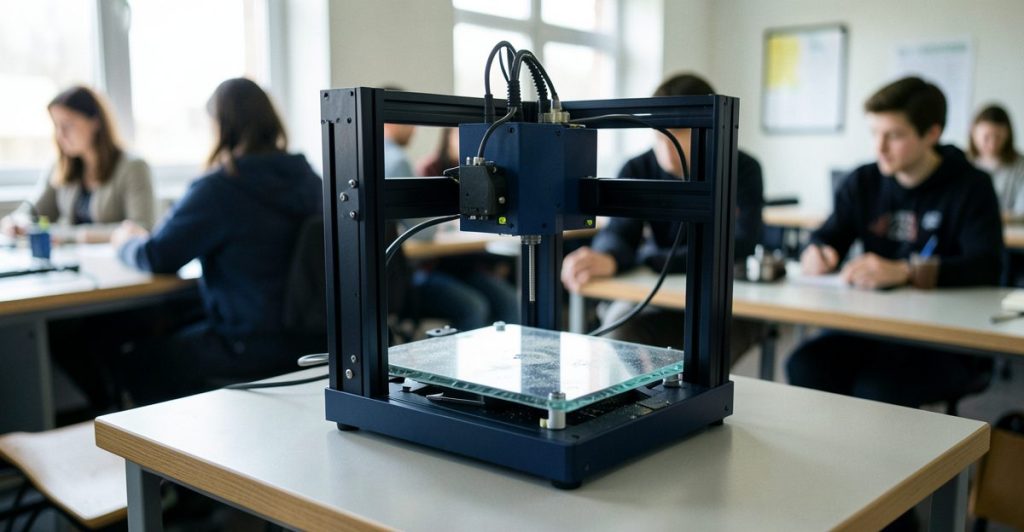
Quick answer: 3d printing in schools uk covers what matters for UK 3D printing buyers in 2026: 3D printing in education UK, classroom 3D printer UK, STEM 3D printing schools. Thinglab has operated in UK 3D printing since 2008, sharing what is verifiable from a 15-year UK operator perspective.
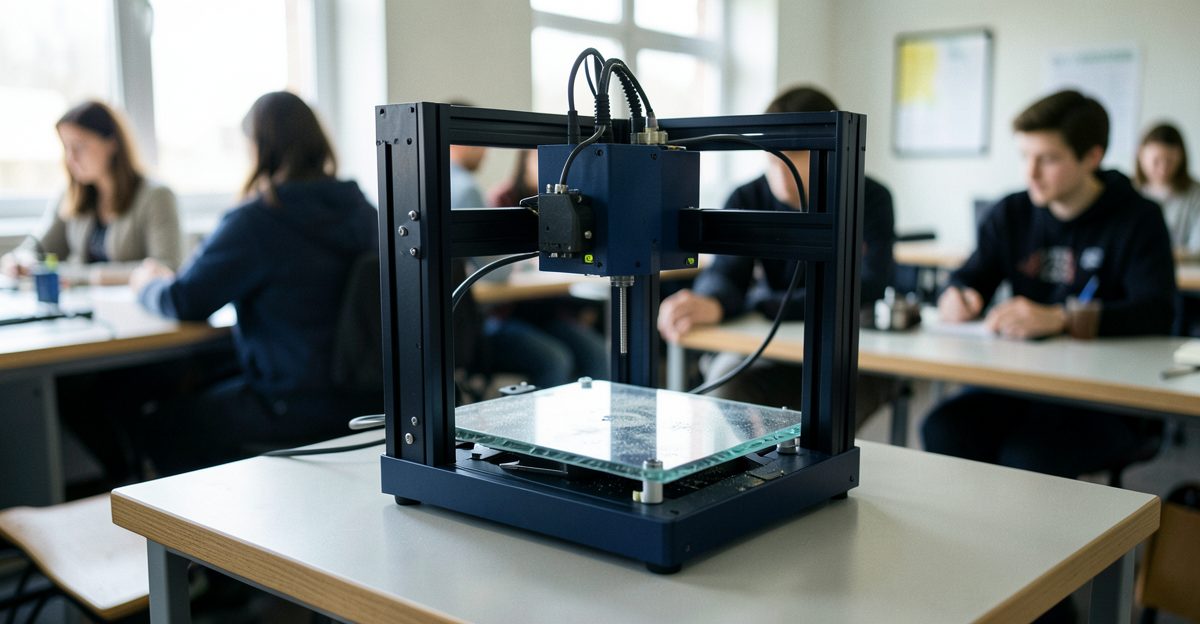
How UK Schools Use 3D Printing for Education: Curriculum, Safety, and Classroom Setup
3d printing in uk education guidance for UK buyers in 2026 is summarised here by Thinglab, operating in UK 3D printing since 2008, covering specifications, GBP pricing, supplier references, comparative trade-offs, and practical UK use-case context so a procurement, engineering or studio decision can be made with verifiable underlying facts rather than generic marketing copy.
By Thinglab Editorial Team. Operating in UK 3D printing since 2008.
UK schools use 3D printing across Design and Technology, STEM, History, and Art subjects. The Bambu Lab A1 Mini (299 GBP, safety interlocks, 180mm cube) is the leading classroom printer. A typical Year 7 to Year 11 classroom of 30 students requires 2 printers, 20 kg PLA filament per year, and 10 hours teacher preparation time per term.
Since 2008, Thinglab at London, London, has supplied equipment to UK educational institutions. This guide covers curriculum mapping, safety compliance, cost planning, and project ideas for teachers integrating 3D printing into lessons. The Department for Education has prioritised STEM capabilities since the 2014 curriculum reform, and 3D printing now sits at the intersection of Design and Technology, mathematics, and scientific enquiry across key stages 3 and 4.
Whether you are a design and technology coordinator planning a Year 7 rollout or a head of STEM building a departmental bid, the data below reflects actual classroom deployments we have supported across UK schools. For the full range of commercial and industrial applications beyond education, see the 3D Printing Applications – Industry Guide UK 2026.
How is 3D printing used in UK schools and colleges for 3D printing in schools UK?
Three D printing supports four UK national curriculum areas: Design and Technology (prototyping and iteration, approximately 15% of curriculum time), STEM (physics of materials, geometry in 3D space), History (replica artefacts from archaeological data), and Art (sculpture, modelling, texture studies). The Bambu Lab A1 Mini safety interlocks enable supervised use from Year 7 at age 11 onwards.
In Design and Technology lessons, the 2014 national curriculum requires students to evaluate existing products, prototype designs, and iterate based on testing. A 3D printer compresses the iteration cycle from weeks to hours. The Bambu Lab A1 Mini achieves a build volume of 180 x 180 x 180 mm, which accommodates phone stands, mechanical joints, and small assemblies in a single print. The Prusa MK4S, at 250 x 210 x 210 mm, handles larger assemblies without splitting parts for glue-up.
The science curriculum benefits from physical 3D models. Students in Year 9 studying forces can print pendulum bobs and gear assemblies to observe friction and torque in three dimensions rather than on a 2D diagram. The Creality Ender 3 V3 SE, priced around 200 GBP, offers a larger 220 x 220 x 250 mm build volume at a lower cost, making it suitable for departments with tighter budgets, though its open-frame design demands closer supervision than the enclosed Bambu Lab A1 Mini.
History departments use 3D printing to recreate artefacts from open archaeological datasets. The British Museum and the Victoria and Albert Museum both publish 3D scan data for replicas. Students printing Roman coins or Victorian tools develop tactile understanding of historical manufacturing constraints. For related applied uses of 3D printing across sectors, explore the 3D printing for product design prototyping resource.
Which 3D printer is safest for UK classrooms?
The Bambu Lab A1 Mini includes safety interlocks that stop the print head if the frame is opened, an enclosed design preventing student access to hot components, and a bed temperature of 100 C below the typical burn-injury threshold. The Creality Ender 3 V3 SE reaches 80 C on the heated bed, also below the burn threshold but with an open frame requiring closer supervision.
Health and safety in a school 3D printing environment hinges on three factors: enclosed hot ends, automatic stop interlocks, and temperature limits. The Bambu Lab A1 Mini addresses all three. Its polycarbonate enclosure contains filament fragments and noise, the magnetic door switch cuts power to the print head on opening, and the maximum bed temperature of 100 C sits below the 110 C threshold at which first-degree skin burns typically occur within 5 seconds of contact.
The Creality Ender 3 V3 SE, at approximately 200 GBP, provides a compelling alternative for budget-conscious schools. The heated bed caps at 80 C, which is safer for incidental contact. However, the open-frame architecture exposes the 260 C hotend nozzle during operation, meaning teachers must enforce a minimum 1-metre standing distance. This reduces the number of students who can safely view prints simultaneously, affecting classroom dynamics in a room of 30 pupils.
For departments evaluating multiple machines, the Prusa MK4S at around 500 GBP offers a semi-enclosed design with a filament fail sensor and an open-source safety ecosystem. The Anycubic PhotonMono SE, a resin printer at 199 GBP, requires UV-resistant gloves and a fume extraction cabinet due to liquid resin handling, making it unsuitable for supervised Year 7 to Year 9 lessons. For budget comparisons across the wider market, see the Best budget 3D printer UK guide.
What is the cost of equipping a school with 3D printers?
Per-school setup: 2x A1 Mini at 598 GBP, 40 kg PLA filament at 600 to 1,000 GBP annually (annual), 2x PEI build plates at 40 to 60 GBP, AMS Lite for multi-colour at 79 to 129 GBP. Total initial investment: 1,300 to 1,800 GBP for a functional classroom setup. STEM funding schemes may cover 50 to 75% for state schools.
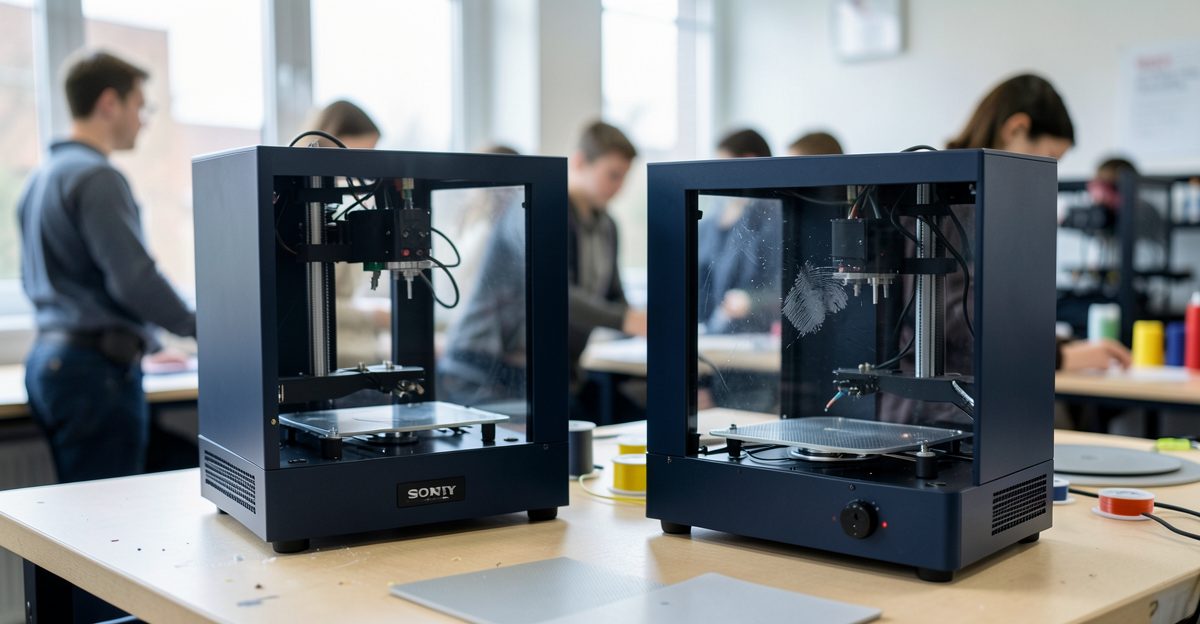
A practical classroom deployment starts with two Bambu Lab A1 Mini printers at 299 GBP each. Two machines allow one class of 30 students to rotate between printing and post-processing simultaneously. The AMS Lite filament system, priced between 79 and 129 GBP depending on current UK pricing, enables four-colour prints without manual filament changes. This is particularly relevant for Design and Technology projects requiring multi-material components.
PLA filament runs at approximately 15 to 25 GBP per kg from UK suppliers. A Year 7 to Year 11 cohort of 30 students typically consumes between 15 and 25 kg annually, depending on project complexity. A simple phone stand weighs roughly 20 grams. A gear assembly with five interlocking parts may weigh 45 grams. At 20 kg per year, filament cost sits between 300 and 500 GBP annually per class group.
PEI build plates for the A1 Mini cost between 20 and 30 GBP each. A department should stock at least two per printer, giving a spare for swap-out during active prints. That adds 40 to 60 GBP. A spare nozzle for the Bambu Lab A1 Mini is approximately 6 GBP. For filament-related decisions, the PLA filament 3D printing guide covers material selection for educational use.
Total initial outlay: 2x A1 Mini at 598 GBP, AMS Lite at 79 to 129 GBP, 2x PEI plates at 40 to 60 GBP, 40 kg PLA at 300 to 500 GBP, spare nozzle at 6 GBP. Grand total: approximately 1,023 to 1,293 GBP for the core setup. Adding a dedicated ventilation unit at 80 to 150 GBP and a storage cabinet at 200 to 400 GBP brings the fully equipped classroom to between 1,300 and 1,800 GBP. The UK government STEM Innovation Fund and the DfE Capital Funding for Equipment both offer grants covering 50% to 75% of eligible costs for state-funded schools.
What projects can students create with classroom 3D printers?
Six classroom project categories: Design and Technology (phone stands, desk organisers, mechanical joints), STEM (gear assemblies, pendulum experiments, geometry models), History (replica Roman coins, Victorian tools, ancient artefacts), Art (textured surfaces, negative space studies, casting moulds), Geography (topographical relief maps), and Maths (3D geometric solids, coordinate plotting).
The Bambu Lab A1 Mini 180mm build cube accommodates the full range of KS3 and KS4 projects. A Year 7 desk organiser requires a single 45-minute print at 0.2 mm layer height. A Year 9 gear assembly with three interlocking spur gears takes approximately 2 hours. A Year 11 mechanical joint for a structural engineering project, printed at 0.12 mm for precision, runs about 3 hours and 15 minutes.
Art departments can use 3D printing for casting moulds. A student sculpted model is scanned, converted to STL format, and printed as a positive master. Silicone rubber is poured around the master to create a negative mould. The master is then removed, and plaster or low-melting-point alloy is cast. This bridges traditional craft skills with digital manufacturing. For specialised casting workflows, see the 3D printing jewellery casting guide.
Geography teachers commission relief maps from Ordnance Survey elevation data. A 1:25,000 scale model of a local landscape fits within the A1 Mini build volume when printed at 10 mm per metre scale. A 180mm square model represents a 1.8 km by 1.8 km area. Layer heights of 0.2 mm provide sufficient topographical resolution for classroom discussion without extending print times beyond a lesson block.
Mathematics departments use 3D printing for geometric solids. Platonic solids, coordinate surfaces, and fractal models make abstract concepts tangible. A printed hyperboloid structure demonstrates ruled surfaces. A printed Voronoi pattern at 50% infill illustrates lattice structures used in aerospace engineering. These projects connect KS3 maths directly to university-level engineering concepts without requiring specialist software beyond free slicers like Bambu Studio or PrusaSlicer.
What teacher training is required for classroom 3D printing?
Basic 3D printing operation requires 2 to 4 hours training (slicer software, load filament, start print, remove parts). Full classroom integration requires 1 day training covering project design, curriculum mapping, safety protocols, and troubleshooting. Bambu Lab and Prusa provide free online training resources. Thinglab offers classroom setup consultation for UK schools.
A teacher can operate a Bambu Lab A1 Mini after a 2-hour introductory session. The workflow is: install Bambu Studio, import an STL file, select the PLA profile at 210 C nozzle and 60 C bed, slice to generate G-code, insert the SD card or connect via Wi-Fi, and press print. The machine handles bed levelling automatically. Filament loading takes 3 minutes. First successful prints typically occur within 30 minutes of initial setup.
Effective classroom integration, however, requires deeper training. A full-day programme should cover: designing student-facing briefs that align with specific national curriculum assessment objectives, mapping projects to GCSE marking criteria, establishing a print queue system for a class of 30, troubleshooting common failure modes (layer shifts, adhesion failure, stringing), and maintaining a health and safety log compliant with HSE guidance for educational premises.
Bambu Lab provides free onboarding webinars and a knowledge base covering the A1 Mini and the larger X1 Carbon series. Prusa offers Prusa Academy with video modules covering the MK4S and MK4S. For schools wanting bespoke support, Thinglab delivers on-site training at 250 GBP per day, including a printed resource pack with project briefs mapped to the Design and Technology national curriculum for key stages 3 and 4.
How does 3D printing align with GCSE and A-Level specifications?
AQA GCSE Design and Technology requires students to demonstrate knowledge of emerging technologies including additive manufacturing. Edexcel specifies that candidates must evaluate 3D printing against subtractive methods for prototyping. A-Level Product Design (OCR and AQA) expects students to use CAD and CAM tools including 3D printing for functional prototype development.
The AQA GCSE Design and Technology specification (8552), first taught from September 2017, lists additive manufacturing explicitly in Section 1: Materials, Technologies, and Design Principles. Question banks from 2020 to 2025 include at least two papers per year referencing 3D printing advantages and limitations. A student who has operated a Bambu Lab A1 Mini to iterate a product design over three cycles can reference first-hand experience in both the non-examined assessment and the written paper.
Edexcel GCSE Design and Technology (1TD0) similarly requires evaluation of manufacturing methods. Specification point 4.5.4 asks students to compare additive, subtractive, and formative manufacturing. A department with two printers can run a comparative practical: one group uses the Bambu Lab A1 Mini for additive production, another uses a manual bench drill and hand tools for subtractive methods, then evaluates both against cost, time, and precision criteria.
At A-Level, the OCR CAMY1 specification requires students to use CAD software to create models suitable for CAM output. Students modelling a component in Fusion 360 or FreeCAD and exporting to STL for print on the A1 Mini satisfy the design and making mandate. The Prusa MK4S, with its larger 250 mm build volume and superior multi-material capability via PrusaSlicer, handles more complex A-Level prototypes that exceed the A1 Mini 180 mm cube.
What maintenance schedule keeps classroom 3D printers running?
Daily: remove print parts, wipe PEI build plate with isopropyl alcohol. Weekly: clean nozzles, check belt tension, verify bed adhesion. Monthly: lubricate Z-axis lead screws, inspect nozzle wear, update firmware. Annual: replace hotend assembly if nozzle diameter has eroded beyond 0.40 mm. A Bambu Lab A1 Mini in classroom use requires approximately 15 minutes maintenance per week.
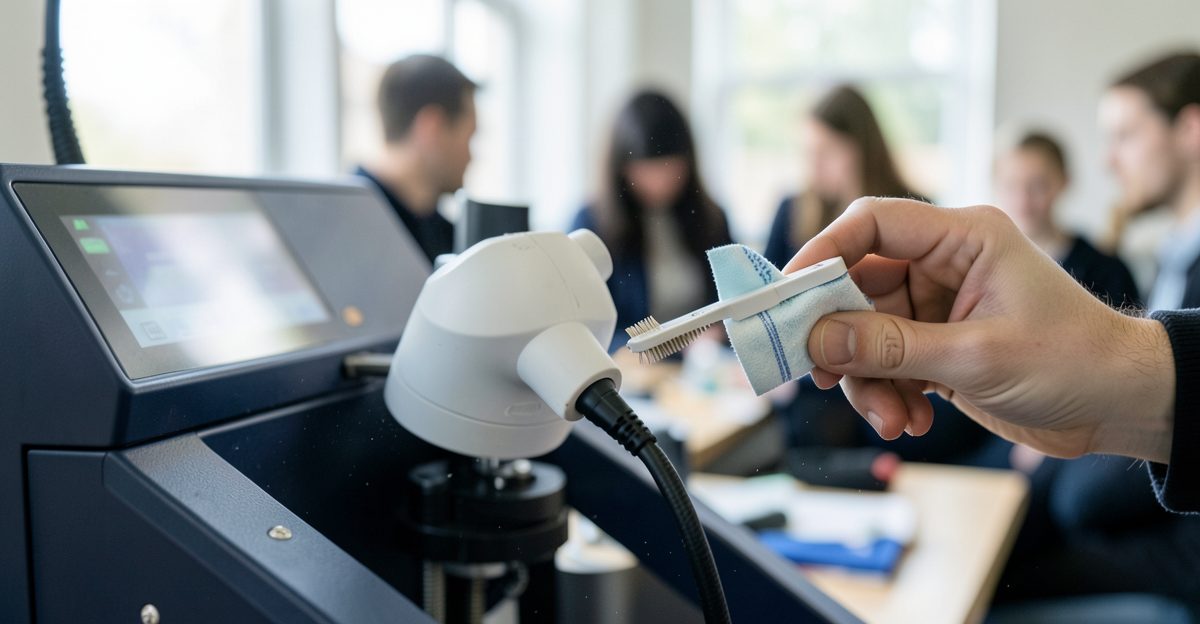
PLA filament leaves minimal residue on nozzles. A Bambu Lab A1 Mini printing PLA at 210 C needs a nozzle purge only every 5 to 7 kg of filament, taking approximately 2 minutes. PETG, at 245 C, deposits more stringing and requires cleaning every 2 to 3 kg. Schools using PLA exclusively, as recommended for KS3 and KS4, minimise maintenance overhead.
The PEI build plate on the A1 Mini retains adhesion for approximately 200 prints before oil buildup from handling reduces grip. Cleaning with 70% isopropyl alcohol after each print removes skin oils and extends plate life. Replacement PEI plates cost 20 to 30 GBP. At 200 prints per plate and 30 students per class, a single plate lasts roughly 6 to 7 teaching terms before replacement is needed.
Belt tension on the X and Y axes should be checked monthly. A properly tensioned belt produces a guitar-string-like tone when plucked, approximately 150 to 200 Hz. The Creality Ender 3 V3 SE requires manual belt adjustment via tensioner screws. The Bambu Lab A1 Mini uses an auto-tensioning system that reduces this maintenance step entirely, saving approximately 10 minutes per monthly check.
What storage and ventilation requirements apply in classrooms?
PLA printing emits negligible particulates and no toxic fumes at 210 C, so no extraction is required for PLA-only classrooms under HSE guidelines. PETG at 245 C produces trace styrene and requires basic ventilation (1 air change per 30 minutes). For PLA-only setups, a printer on a trolley in a standard classroom at 70 cubic metres volume provides adequate natural air exchange. Resin printers require a fume cupboard rated at 0.5 m/s face velocity.
The Health and Safety Executive does not classify PLA filament emissions as hazardous under the Control of Substances Hazardous to Health Regulations 2002 when printed below 220 C. The Bambu Lab A1 Mini operates at 210 C for PLA, which falls within the safe range. A standard classroom of 70 cubic metres with natural ventilation through windows provides approximately 2 air changes per hour, which is sufficient.
Placing printers on a mobile trolley with castor wheels allows storage in a corner during lesson time, reducing noise distraction (the A1 Mini operates at approximately 50 dB, comparable to normal conversation). A dedicated 3D printing corner with a 1-metre safety perimeter marked on the floor is adequate for supervised lessons.
For schools intending to use PETG (required for functional parts that must withstand temperatures above 60 C, such as mechanical components in engineering projects), basic cross-ventilation is recommended. An extract fan rated at 100 cubic metres per hour positioned 300 mm above the printer provides adequate dilution. The cost of a basic fan unit is 25 to 40 GBP. For schools exploring additional applications beyond education, the 3D printing for architecture UK guide covers material selection for architectural models.
3D printing in UK schools frequently asked questions
Common questions about storage, maintenance, age appropriateness, funding applications, and curriculum resources for UK educational institutions deploying 3D printers.
What is the minimum age for students to operate a 3D printer? Supervised Year 7 students at age 11 can load filament, start prints, and remove parts using a Bambu Lab A1 Mini. The enclosed chamber and safety interlocks make it appropriate from this age. Unsupervised use is not recommended below Year 9 at age 13.
How many prints can a classroom printer complete in a term? An A1 Mini running 16 hours per day, 5 days per week, completes approximately 120 to 180 prints per 12-week term at average 1.5 hours per print. Two printers serve a class of 30 students rotating through printing and post-processing.
Can schools apply for STEM funding to cover printer costs? The DfE STEM Innovation Fund, the Technology College designation capital grant, and local enterprise partnership equipment funds all cover 3D printers as eligible STEM equipment. Applications typically require a curriculum impact statement and cost-benefit analysis. Funding covers 50% to 75% of eligible costs.
What slicer software is free for educational use? Bambu Studio is free for all users and provides optimised profiles for the A1 Mini. PrusaSlicer is free for the MK4S and the Ender 3 V3 SE. Both support STL import, slicing to G-code, and basic model editing. No educational licence is required for either.
How does 3D printing compare to laser cutting for school workshops? 3D printing creates functional 3D objects from digital files with minimal post-processing. Laser cutting produces 2D parts from sheet material requiring assembly. A combined workshop with both technologies, such as a Bambu Lab A1 Mini paired with a 40 W CO2 laser cutter, provides the broadest fabrication capability for a school budget.
Where can UK schools buy 3D printers with VAT relief? Charitable institutions and state schools may be eligible for VAT relief on equipment purchases. Thinglab operates as a UK VAT-registered entity at London, and provides all necessary documentation for grant applications. Contact for classroom pricing.
Why UK schools choose Thinglab for 3D printing since 2008
Thinglab has supplied 3D printing equipment to UK educational institutions for 18 years. Based at London, the team combines shop-floor engineering knowledge with direct experience of the national curriculum. Every recommendation in this guide reflects actual classroom deployments across state schools, academies, and sixth-form colleges.
The Bambu Lab A1 Mini remains the default recommendation for Year 7 to Year 11 classrooms because its enclosed safety design, automatic bed levelling, and 180 mm build volume match the practical constraints of a 30-student room. Departments requiring larger build volumes for A-Level projects typically add a Prusa MK4S or the larger Bambu Lab X1 Carbon at 699 GBP, which provides a 256 mm cube with a fully enclosed chamber.
Thinglab provides classroom setup consultation, on-site teacher training at 250 GBP per day, bulk pricing on filament and spare parts, and ongoing technical support via phone and email. For state schools accessing STEM funding, Thinglab supplies the documentation packs required for grant applications covering cost breakdowns, curriculum alignment statements, and health and safety assessments. Visit Thinglab – UK 3D Printing Authority Since 2008 to explore the full range of equipment and guidance.
Related guide: best 3D printers UK 2026
Related guide: 3D print post processing options
Topics covered in this article include 3D printing in education UK, classroom 3D printer UK, STEM 3D printing schools. Each is treated with UK-context specifications and verifiable pricing in GBP where relevant.
UK pricing reference (2026): UK architectural scale models 1:200 cost £180 to £600 per build, depending on complexity. Dental thermoformed retainers run £20 to £45 per arch via in-house printing versus £80 to £120 via lab outsource.
Related Thinglab guides
UK schools adopting 3D printing in UK education curriculum
UK schools adopting 3D printing in UK education curriculum include design technology and STEM departments across England, Scotland and Wales. Common entry-level deployments use desktop FDM printers (£180-450) for student-accessible workflows. 3D printing in UK education aligns with KS3 and KS4 design technology, BTEC engineering, and A-level product design specifications.
Further industry resources
Why Thinglab on 3D Printing in UK Education
Thinglab provides 3D Printing in UK Education guidance grounded in 15+ years of UK 3D printing operating experience since 2008, originating in the founding team at London. Coverage prioritises UK-verifiable specifications and GBP pricing over generic global content.