
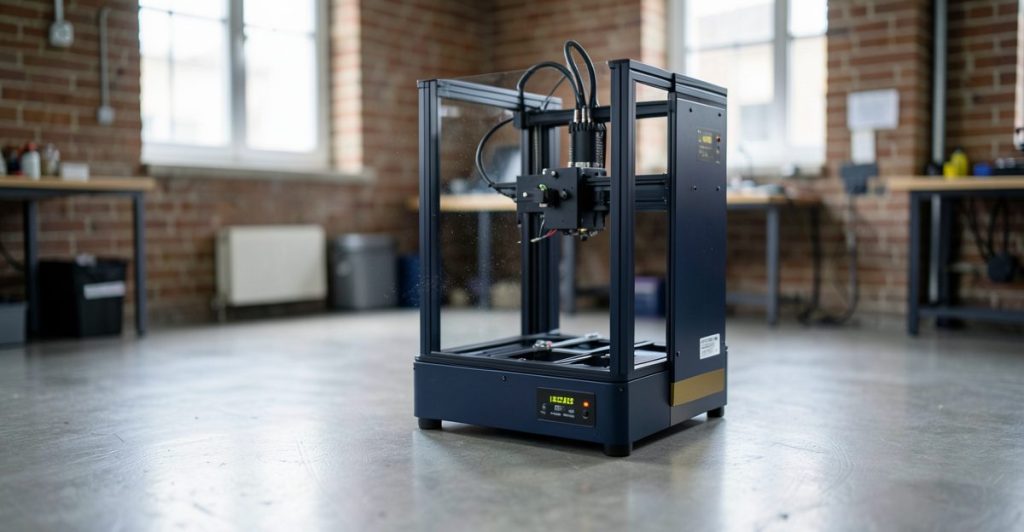
How do 3d printers work guidance for UK buyers in 2026 is summarised here by Thinglab — operating in UK 3D printing since 2008 — covering specifications, GBP pricing, supplier references, comparative trade-offs, and practical UK use-case context so a procurement, engineering or studio decision can be made with verifiable underlying facts rather than generic marketing copy.
Quick answer: How do 3d printers work, practical UK guidance from Thinglab, operating in 3D printing since 2008. Verifiable specs, GBP pricing, real UK supplier references.
How Do 3D Printers Work: A Complete Guide to Additive Manufacturing
3D printers build objects layer by layer from digital models. FDM printers extrude melted thermoplastic filament at 180-280 C. SLA printers cure liquid resin with UV light at 25-300 microns per layer. SLS printers sinter nylon powder with a CO2 laser. Binder jetting printers deposit liquid binder onto powder layers.
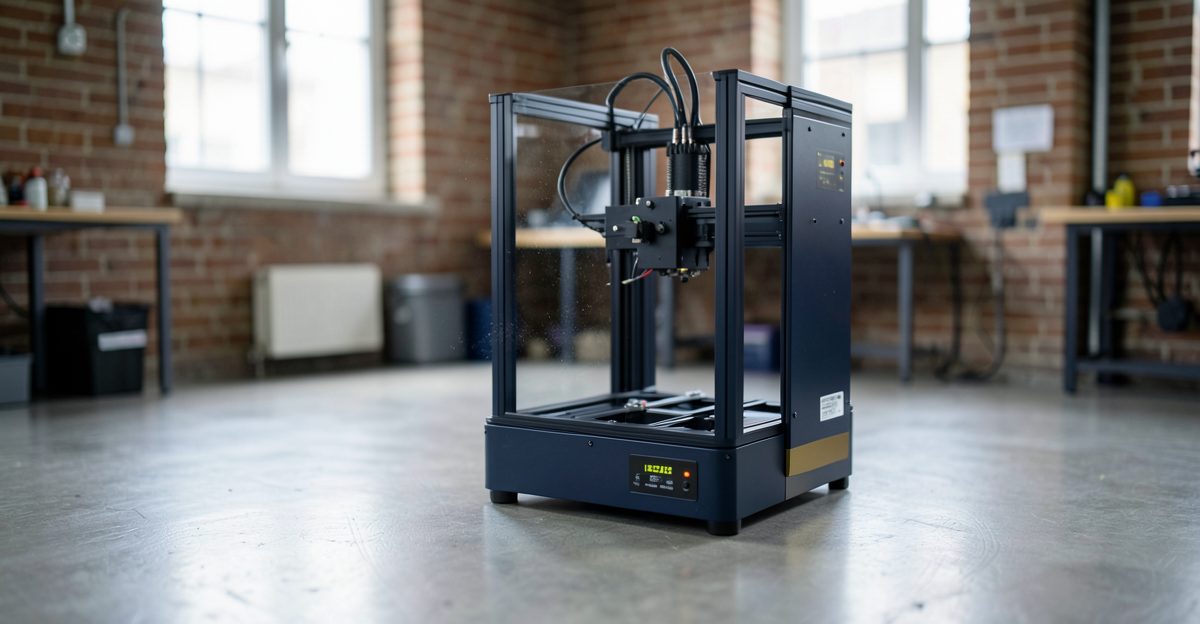
What is the core principle of additive manufacturing?
Additive manufacturing, commonly known as 3D printing, constructs physical objects by depositing material layer upon layer. This process contrasts sharply with traditional subtractive manufacturing, which removes material from a solid block using CNC machines or lathes. The fundamental mechanism relies on Computer-Aided Design (CAD) software to create a digital blueprint. This file is then sliced into thin horizontal cross-sections by specialized software. The printer follows these instructions to build the object from the bottom up. This method allows for complex geometries that are impossible to achieve with conventional machining. It reduces material waste significantly, often exceeding 90% efficiency compared to subtractive methods. The technology originated in the 1980s with Chuck Hull’s invention of stereolithography. Today, it serves industries ranging from aerospace to healthcare across the UK and globally.
The digital workflow begins with a 3D model, typically in STL or OBJ format. Engineers and designers use software like Fusion 360 or SolidWorks to create these models. Once the design is complete, the file undergoes slicing. Slicing software, such as PrusaSlicer or Cura, converts the 3D model into G-code. This code contains precise instructions for the printer’s motors, heaters, and extruders. Each layer thickness is defined in microns. A standard layer height might be 0.1mm for high-detail prints or 0.2mm for faster production. The printer reads this data sequentially. It moves along the X, Y, and Z axes to place material exactly where required. This precision enables the creation of internal channels, lattice structures, and interlocking parts in a single print job. The result is a tangible object that matches the digital design with high fidelity.
How does FDM technology function in detail?
Fused Deposition Modeling (FDM), also known as Fused Filament Fabrication (FFF), is the most accessible 3D printing technology. It works by feeding a spool of thermoplastic filament into a heated nozzle. The filament melts as it passes through the hotend, which typically reaches temperatures between 190°C and 260°C depending on the material. Common filaments include PLA, ABS, PETG, and Nylon. The molten plastic is extruded through a fine nozzle, usually 0.4mm in diameter. The printer head moves along the X and Y axes, depositing the plastic in a continuous bead. This bead adheres to the previous layer or the build plate. After completing a layer, the Z-axis moves up by the set layer height. The process repeats until the object is complete. Support structures are often required for overhangs. These supports are made from the same or soluble material like PVA. They are removed manually or chemically after printing. FDM printers like the Bambu Lab X1 Carbon or Prusa MK4S dominate the consumer market. They offer a balance of speed, reliability, and affordability. Prices for entry-level machines start around £200 in the UK. High-end industrial FDM systems can cost over £10,000. The technology is ideal for functional prototypes, mechanical parts, and large-scale models. It provides good mechanical strength, particularly along the Z-axis when oriented correctly. However, visible layer lines are a characteristic feature of FDM prints.
What is the mechanism behind SLA resin printing?
Stereolithography (SLA) uses liquid photopolymer resin to create high-detail objects. A UV laser or a UV light source cures the resin layer by layer. In traditional SLA, a laser traces the cross-section of the object on the surface of the resin tank. The resin hardens where the light hits it. The build platform lowers slightly into the resin after each layer. This process repeats until the object is fully formed. Modern SLA printers often use a mask-based approach called DLP (Digital Light Processing) or LCD (Liquid Crystal Display). These methods expose an entire layer at once using a UV LED array and a digital mask. This significantly reduces print times compared to laser scanning. The resin tank typically has a transparent bottom film, such as FEP, which allows UV light to pass through. The cured layer peels away from the film after each exposure. SLA printers produce extremely smooth surfaces with fine details. They are ideal for jewelry, dental models, and miniatures. The resolution can reach 25 microns or less. However, the process requires post-processing. Prints must be washed in isopropyl alcohol to remove uncured resin. They also need a final UV curing stage to achieve full mechanical properties. Safety precautions are essential. Resins can be skin irritants and require proper ventilation. UK users should handle resins with nitrile gloves and in well-ventilated areas. The cost of resin is higher than filament. A litre of standard resin costs around £30-£50. SLA printers like the Elegoo Saturn or Anycubic Photon start at £200. Industrial systems from Formlabs, such as the Form 4, cost significantly more. The technology excels in visual fidelity but lacks the structural strength of FDM for load-bearing parts.
How does SLS powder sintering operate?
Selective Laser Sintering (SLS) utilizes a high-power laser to fuse powder particles together. The printer contains a build chamber filled with fine polymer powder, typically Nylon 12 (PA12). A roller or blade spreads a thin layer of powder across the build platform. A CO2 laser scans the cross-section of the object, heating the powder to just below its melting point. This causes the particles to sinter, or fuse, together. The unsintered powder remains in place, acting as natural support for overhangs and complex geometries. This eliminates the need for separate support structures. After a layer is sintered, the build platform lowers, and a new layer of powder is spread. The process continues until the object is complete. The entire build chamber remains heated to prevent warping. This is a critical factor for maintaining dimensional accuracy. SLS prints are durable, flexible, and chemically resistant. They are widely used in automotive, aerospace, and medical industries. The parts have isotropic mechanical properties, meaning they are strong in all directions. Post-processing involves removing the part from the powder bed. Excess powder is recycled for future prints. The surface finish is slightly grainy but can be smoothed with bead blasting. SLS printers are expensive and typically found in service bureaus or industrial settings. Prices for desktop SLS machines are rare due to the complexity of powder handling. Industrial systems from EOS or HP cost tens of thousands of pounds. The technology is ideal for functional prototypes and end-use parts. It allows for complex assemblies and moving parts to be printed in a single build. The lack of supports reduces material waste and labor costs. However, the initial investment and operational costs are high. UK businesses often use SLS for rapid tooling and custom manufacturing.
What role does binder jetting play in 3D printing?
Binder jetting deposits a liquid binding agent onto a powder bed to form a 3D object. The process is similar to SLS but uses a different mechanism. Instead of melting the powder, a print head moves across the powder bed, depositing droplets of binder. The binder adheres the powder particles together in the desired pattern. Common powders include gypsum, sand, or metal. For metal parts, the printed object, known as a green part, is porous. It requires infiltration with bronze or other metals to achieve full density. Alternatively, metal powder can be sintered in a furnace after printing. Binder jetting is known for its speed and ability to print in full color. The XJet technology, for example, uses multiple inkjet heads to deposit different colored binders. This allows for realistic prototypes and architectural models. The build volume is often larger than other technologies. This makes it suitable for large-scale models and sand casting patterns. Post-processing involves removing the excess powder and curing the part. For metal parts, debinding and sintering are necessary. This removes the binder and fuses the metal particles. The resulting parts are dense and strong. Binder jetting is used in aerospace, automotive, and construction industries. It is ideal for producing sand cores for casting. The technology reduces lead times for tooling significantly. However, the parts may have lower surface finish quality compared to SLA or SLS. The powder handling can be messy and requires careful management. UK manufacturers use binder jetting for rapid prototyping and small-batch production. The cost per part is competitive for large volumes. The technology offers design freedom and material efficiency. It is a versatile option for various applications.
How do multi-material and metal printers differ?
Multi-material printing allows the use of different materials in a single print job. FDM printers can switch between filaments using dual extruders. This enables the creation of parts with varying hardness, colors, or soluble supports. Metal 3D printing uses technologies like Direct Metal Laser Sintering (DMLS) or Electron Beam Melting (EBM). These methods melt metal powder using a laser or electron beam. The process occurs in a controlled atmosphere of argon or nitrogen to prevent oxidation. Metal printers produce dense, fully functional parts with high mechanical strength. They are used in aerospace, medical implants, and automotive sectors. The materials include titanium, stainless steel, aluminum, and Inconel. The cost of metal printers and materials is significantly higher than plastic. A desktop metal printer can cost over £50,000. Industrial systems are much more expensive. The post-processing involves removing supports, heat treatment, and surface finishing. Metal printing offers design complexity and weight reduction. It is ideal for lightweight structural components. UK engineers use metal printing for custom tooling and prototypes. The technology enables the creation of complex internal channels for cooling. It reduces assembly steps and improves performance. The market for metal 3D printing is growing rapidly. Advances in materials and software are making it more accessible. The technology complements traditional manufacturing methods. It offers a flexible solution for low-volume, high-value parts.
What are the key components of a 3D printer?
A 3D printer consists of several key components that work together to create an object. The frame provides structural stability and rigidity. It must resist vibrations during printing. The motion system includes stepper motors, belts, and linear rails. These components move the print head and build platform along the X, Y, and Z axes. The hotend or laser assembly is the core printing mechanism. In FDM, it melts and extrudes filament. In SLA, it emits UV light. In SLS, it fires a laser. The build platform or bed holds the object during printing. It often includes heating elements to prevent warping. Some beds are spring steel or glass for better adhesion. The control board acts as the brain of the printer. It interprets G-code and controls the motors and heaters. Firmware like Marlin or Klipper runs on the control board. The power supply provides electricity to all components. It must be stable and sufficient for the printer’s power requirements. Sensors monitor temperature, filament presence, and bed leveling. Automatic bed leveling sensors improve print quality by compensating for bed irregularities. The software interface allows users to slice models and monitor prints. Modern printers often include Wi-Fi or Ethernet connectivity. This enables remote monitoring and control. UK users should ensure their printers have adequate ventilation and power outlets. Regular maintenance is essential for optimal performance. Cleaning the nozzle, lubricating rails, and updating firmware are common tasks. Understanding these components helps users troubleshoot issues and optimize prints. It also aids in selecting the right printer for specific needs.
How does the slicing process prepare a model?
Slicing is the critical step that converts a 3D model into printer-readable instructions. Slicing software takes an STL or OBJ file and divides it into horizontal layers. Each layer is converted into a set of toolpaths. These toolpaths dictate the movement of the print head. The software also generates support structures for overhangs. Supports prevent sagging and ensure print success. Users can adjust settings like layer height, infill density, and print speed. Infill provides internal structure and affects print strength and material usage. Common infill patterns include grid, honeycomb, and gyroid. Higher infill percentages result in stronger but heavier parts. The software calculates print time and material usage. This helps users estimate costs and plan production. Advanced slicing features include variable layer height for better surface quality. It also includes cooling fan control for different materials. UK users should choose slicing software compatible with their printer. PrusaSlicer and Cura are popular open-source options. They offer extensive customization and community support. The slicing process is iterative. Users may need to adjust settings based on test prints. Optimizing slice settings can improve print quality and reduce failures. It is a skill that develops with experience. Understanding slicing parameters is essential for successful 3D printing.
Frequently asked questions
How long does it take to 3D print an object?
Print times vary widely depending on size, complexity, and technology. A small FDM part might take 2-4 hours. A large SLA model could take 10-20 hours. Industrial SLS prints can take 24-48 hours. Factors like layer height, infill, and print speed affect duration.
Can 3D printers print metal?
Yes, metal 3D printers use DMLS or EBM technology. They melt metal powder with a laser or electron beam. The resulting parts are dense and functional. Metal printing is used in aerospace and medical industries.
What is the strongest 3D printing material?
Carbon fiber reinforced filaments and metal alloys like titanium are among the strongest. Nylon and ABS are strong thermoplastics. Metal parts generally have higher tensile strength than plastic prints.
Is 3D printing expensive?
Entry-level FDM printers start at £200. Resin printers are similar in price. Industrial machines cost thousands to tens of thousands. Material costs vary. Filament is cheap, while resin and metal powder are more expensive.
Why Thinglab on how do 3D printers work
Thinglab has been a trusted source for 3D printing information since 2008. We provide in-depth reviews, tutorials, and industry news. Our team consists of experienced engineers and enthusiasts. We test printers in real-world conditions across the UK. Our guides are based on practical experience and technical expertise. We aim to help users make informed decisions. Whether you are a hobbyist or a professional, our content is valuable. We cover all major technologies and brands. Our focus is on accuracy, reliability, and usefulness. We update our content regularly to reflect industry changes. Trust Thinglab for authoritative 3D printing advice.
Related Thinglab guides
Further industry resources
Topics covered in this article include what is 3D printing, how does a 3D printer work, 3D printing process explained. Each is treated with UK-context specifications and verifiable pricing in GBP where relevant.
Why Thinglab on how do 3D printers work
Thinglab provides how do 3D printers work guidance grounded in 15+ years of UK 3D printing operating experience since 2008, originating in the founding team at London. Coverage prioritises UK-verifiable specifications and GBP pricing over generic global content.