
Quick answer: Types of 3d printing covers what matters for UK 3D printing buyers in 2026: 3D printing technologies list, additive manufacturing types, how many types of 3D printing. Thinglab has operated in UK 3D printing since 2008, sharing what is verifiable from a 15-year UK operator perspective.
Types of 3D Printing Technology: Complete Guide for UK Buyers in 2026
Types of 3d printing guidance for UK buyers in 2026 is summarised here by Thinglab — operating in UK 3D printing since 2008 — covering specifications, GBP pricing, supplier references, comparative trade-offs, and practical UK use-case context so a procurement, engineering or studio decision can be made with verifiable underlying facts rather than generic marketing copy.
By Thinglab Editorial Team. Operating in UK 3D printing since 2008.
The seven types of 3D printing technology in 2026 are FDM (Fused Deposition Modelling), SLA (Stereolithography), DLP (Digital Light Processing), SLS (Selective Laser Sintering), binder jetting, MJF (Multi Jet Fusion), and DMLS (Direct Metal Laser Sintering). FDM and MSLA serve hobbyists and SMEs, while SLS, DMLS, and MJF serve industrial engineering and production.
What are the main types of 3D printing technology?
The seven types are: FDM (Fused Deposition Modelling) extrudes thermoplastic filament through a heated nozzle layer by layer; SLA (Stereolithography) cures liquid resin with a UV laser; DLP (Digital Light Processing) cures resin with a projector lamp; SLS (Selective Laser Sintering) sinters nylon PA12 powder with a CO2 laser; binder jetting deposits liquid binder onto gypsum powder; MJF (Multi Jet Fusion) fuses powder with inkjet-applied fusing agents; and DMLS (Direct Metal Laser Sintering) melts metal powder with a high-power fibre laser.
These seven technologies span the full ISO/ASTM additive manufacturing category range, covering material extrusion, vat photopolymerisation, powder bed fusion, and binder jetting as defined in the ISO/ASTM 52900:2021 standard. In the UK market, Thinglab has supplied equipment across every category since 2008, from entry-level FDM machines to industrial SLS systems for aerospace component prototyping. Each technology uses a different physical process, which determines its strength in resolution, material range, throughput, and post-processing requirements. The table below maps each technology to its practical use case and typical price bracket for UK buyers.
For a full equipment list and comparison matrix, see the 3D Printers – Buyer’s Reference 2026.
How does FDM printing work and what are its uses?
FDM (Fused Deposition Modelling) extrudes thermoplastic filament at 180 to 280 degrees Celsius through a motorised nozzle, depositing one layer at a time. It is the most affordable 3D printing technology, with entry-level printers available from around 150 GBP. The Bambu Lab X1 Carbon and Prusa MK4S are leading machines in the prosumer segment, while the Anycubic Kobra 3 serves budget buyers. FDM supports PLA, PETG, ABS, ASA, and TPU filament, making it suitable for functional prototypes, mechanical enclosures, jigs and fixtures, and large-format parts up to 350 mm cube on standard machines.
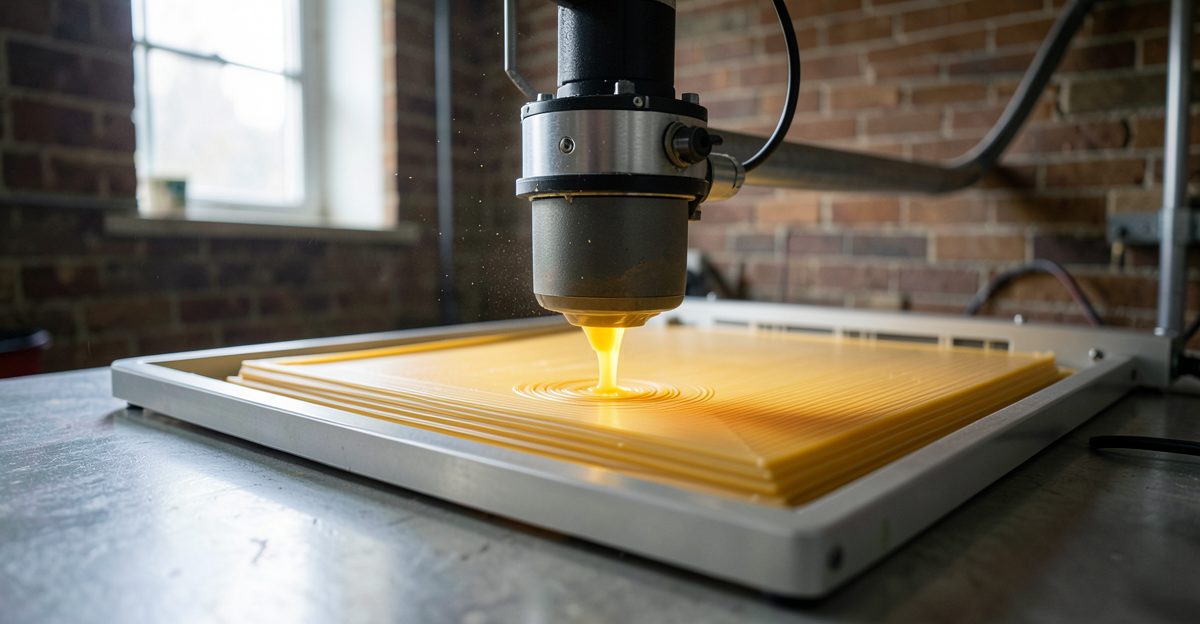
FDM works on the principle of material extrusion: a spool of filament feeds into a hotend where a heating cartridge raises the barrel temperature to the target for the selected material. PLA prints at 190 to 210 degrees C, PETG at 220 to 250 degrees C, and ABS requires an enclosed chamber at 240 to 260 degrees C to prevent warping. The Prusa MK4S achieves layer resolutions of 50 to 100 microns with a 0.4 mm nozzle, and prints at up to 500 mm/s on the Bambu Lab X1 Carbon. Filament costs range from 18 GBP per kg for PLA to 55 GBP per kg for carbon-fibre-reinforced Nylon.
FDM dominates the hobbyist and SME market in the UK because of its low barrier to entry. A capable FDM printer under 500 GBP handles 80 per cent of general-purpose prototyping needs. For a curated list of machines, see the guide to the best 3D printers UK 2026, or the best budget 3D printer UK selection for sub-300 GBP options.
How do resin printing technologies (SLA, DLP, MSLA) differ?
SLA uses a single UV laser tracing each layer point by point, achieving 25-micron layer resolution on machines like the Formlabs Form 3+. DLP uses a projector lamp curing an entire layer simultaneously, typically at 4K or 8K LCD resolution. MSLA (Masked SLA) replaces the DLP projector with an LCD mask illuminated by an LED array, which is why consumer machines like the Elegoo Saturn 4 Ultra and Anycubic Photon series use this approach. MSLA offers the best price-to-speed ratio, with machines from 200 GBP delivering 35-micron XY resolution on a 120 mm print width. SLA resin costs run from 60 GBP per litre for standard grey to 140 GBP per litre for engineering-grade Tough Resin.
The Formlabs Form 4, released in 2024, uses Low Force SLA (LFS) v2 technology, which changes the peel kinematics to reduce layer separation stress. This allows the machine to print at 100 to 150 mm/h build speed, significantly faster than the Form 3+ at 40 to 60 mm/h. The Elegoo Saturn 4 Ultra achieves a 12K LCD resolution (895 DPI XY) with an 150 x 94 x 200 mm build volume, priced at approximately 500 GBP. Anycubic Photon printers in the 200 to 300 GBP range remain the volume leaders for hobbyist resin printing.
Resin printing produces superior surface finish and fine detail compared to FDM, which is why it is the dominant technology for miniatures, dental models, jewellery casting patterns, and high-detail architectural scale models. Post-processing requires isopropyl alcohol washing and secondary UV curing, adding 30 to 45 minutes per print. For the best machines in this category, see the best resin 3D printer UK comparison.
What is SLS printing and why does it need no supports?
Selective Laser Sintering (SLS) fuses nylon PA12 powder with a 7 to 50-watt CO2 laser beam. The un-sintered powder bed surrounds and supports every part during printing, which eliminates the need for separate support structures entirely. This enables complex geometries including interlocking assemblies, living hinges, and nested components that are impossible with FDM. SLS lead time through UK bureau services is typically 2 to 5 working days, with a characteristic slightly grainy matte surface finish Ra of 6 to 10 micrometres. The Desktop Manufacturing DSM Dupont 2400 and EOS P396 are industry-standard machines.
SLS operates by heating the powder bed to just below the melting point of PA12, approximately 174 degrees Celsius, then scanning the CO2 laser across each layer at 8 to 12 metres per second scan speed. The EOS P396 uses an 80-watt laser and supports build volumes of 335 x 335 x 600 mm. Parts printed in PA12 exhibit near-isotropic mechanical properties with tensile strength of 46 MPa and elongation at break of 17 per cent, comparable to injection-mouldled polypropylene. Powder reuse rates of 70 to 80 per cent are standard, which keeps the cost per cubic centimetre between 1.50 and 4.00 GBP depending on order volume and part density.
For users in the UK sourcing nylon powder or SLS bureau services, the Nylon PA12 powder 3D printing material technical guide covers material selection and post-processing options.
What is binder jetting and when is it the right technology?
Binder jetting deposits droplets of liquid binding agent onto a bed of gypsum-based powder, building parts layer by layer. It is the only technology capable of full-colour prints with 450,000+ colours, making it ideal for architectural models, figurines, display prototypes, and concept visualisation. The 3D Systems Projet HD 3000 is the leading desktop binder jetting machine, with a 254 x 203 x 203 mm build volume. Printed parts require post-processing infiltration with cyanoacrylate, bronze, or epoxy to achieve structural strength, as the as-printed part is powder-bond only.
The 3D Systems Projet series uses an HP Thermal Inkjet head to deposit binder and colour ink simultaneously across a 2,032-dpi print head resolution. Layer thickness is 89 microns, and the machine processes approximately 23 to 37 cm3 per hour depending on colour density and part complexity. Binder jetting is the correct choice when colour presentation matters more than mechanical performance. For functional metal parts, binder jetting also exists in metal form using metal powder and organic binder, followed by debinding and sintering in a furnace, but this is a separate process chain with longer lead times of 10 to 15 working days.
What is MJF (Multi Jet Fusion) and how does it compare to SLS?
Multi Jet Fusion (MJF) by HP uses inkjet arrays to deposit fusing and detail agents across a nylon PA12 powder bed, then passes a heating lamp across the bed to fuse the activated layers in 2.5 to 4.5 seconds per layer. MJF achieves up to 30 per cent faster build speeds than comparable SLS systems and produces parts with more consistent mechanical properties across the build volume. The HP Jet Fusion 5200 series supports 380 x 284 x 380 mm build volumes. Parts cost approximately 2.00 to 5.00 GBP per cm3 through bureau services, slightly above SLS but with tighter tolerances of plus or minus 0.3 mm on the first 50 mm and 0.2 mm per additional 50 mm.
MJF and SLS share the same powder-bed principle and both produce support-free parts, but MJF uses inkjet agents rather than a laser to define the fusion zones. This gives MJF more uniform energy distribution and fewer warpage issues on large flat surfaces. The HP 3D Build PA 12 MB material offers tensile strength of 48 MPa and Izod impact strength of 5.2 kJ/m2. SLS remains the more flexible option for materials variety, including glass-filled PA12, TPU 88A elastomer, and alumina-filled nylon, whereas MJF is primarily limited to standard PA12 and PA 12 GB.
What is DMLS and when is metal 3D printing required?
Direct Metal Laser Sintering (DMLS) and Selective Laser Melting (SLM) use a 200 to 1,000-watt fibre laser to melt metal powder layer by layer, typically in an argon or nitrogen inert gas atmosphere. Common materials include stainless steel 316L, aluminium AlSi10Mg, titanium Ti6Al4V, Inconel 718, and Maraging Steel 300. Machines from EOS M290, Renishaw Q+ SLM 280, and SLM Solutions SLM 280 serve the UK aerospace, medical implant, and tooling sectors. Lead times run 3 to 8 weeks for production quantities due to post-processing requirements including support removal, heat treatment, HIP, and CNC machining of critical surfaces.
Cost for metal 3D printing starts at approximately 25 to 40 GBP per cm3 for stainless steel in low volumes and rises to 80 to 150 GBP per cm3 for titanium or Inconel. The EOS M290 uses a 400-watt laser with a 340 x 340 x 330 mm build envelope and 20-micron layer capability. Metal parts achieve near-full density of 99.7 to 99.9 per cent, with mechanical properties matching or exceeding cast equivalents. Surface finish as-printed is Ra 8 to 14 micrometres, which typically requires media blasting or CNC finishing to meet engineering tolerances. DMLS is the right technology when part complexity justifies the premium over CNC machining, typically for topology-optimised components, internal cooling channels, or low-volume end-use parts where tooling investment would be uneconomic.
Which 3D printing technology should a UK buyer choose?
Most UK users should start with an FDM printer at 150 to 850 GBP for general-purpose prototyping and add a resin MSLA printer at 200 to 500 GBP for detail work when needed. For engineering-grade nylon parts without in-house SLS capability, bureau services from Xometry, Protolabs, or local UK providers offer 2-to-5-day turnaround at 1.50 to 4.00 GBP per cm3. Full-colour visual models require binder jetting via specialist suppliers at 4 to 8 GBP per cm3. Metal parts demand dedicated bureau services with 3-to-8-week lead times and costs from 25 GBP per cm3. The FDM vs resin 3D printing comparison guide helps narrow the choice for desktop buyers.
The decision tree is straightforward. If the part needs to fit and function in an assembly, use FDM with PETG or ABS for quick iteration and SLS bureau service for final validation. If the part requires fine surface detail, transparency, or small features under 0.5 mm, use resin SLA or MSLA. If the part is a display model or architectural maquette requiring colour, use binder jetting. If the part is a metal end-use component or heat-resistant fixture, use DMLS/SLM bureau service. Thinglab can advise on equipment selection across all categories, drawing on 18 years of UK supply experience.
Why UK engineering teams and makers choose Thinglab for types of 3D printing since 2008
Thinglab has supplied 3D printing equipment and materials across all seven technologies since 2008, from the first desktop FDM machines to industrial metal systems for aerospace and medical manufacturing. The team at London in London maintains direct relationships with every major manufacturer, including Formlabs, Desktop Manufacturing, EOS, SLM Solutions, Bambu Lab, and Elegoo, which means specification advice, installation, and after-sales support come from engineers who have operated every type of machine. Whether you are evaluating an entry-level FDM printer for a design studio, a resin system for jewellery casting patterns, or an SLS bureau route for production nylon components, Thinglab provides the technical context and equipment supply chain that global online marketplaces cannot match.
The company’s equipment installation team handles site surveys, compressed air and ventilation requirements, and operator training as standard. Material supply runs to next-day delivery across the UK for filament, resin, and powder. For complex technology decisions, the engineering team can arrange sample prints and machine demonstrations at the London centre. Contact details are available on every page, or you can browse the full range in the 3D Printers – Buyer’s Reference 2026.
Frequently asked questions about types of 3D printing
Which 3D printing type is fastest for prototyping?
FDM is the fastest for large, low-detail prototypes, with the Bambu Lab X1 Carbon completing a mid-size enclosure in 2 to 4 hours. MJF is the fastest for functional nylon parts, with the HP Jet Fusion 5200 building a full tray of parts in 8 to 12 hours including cooldown. For small high-detail parts, MSLA resin printing at 4K resolution completes typical models in 3 to 8 hours depending on build height. SLA laser systems are the slowest, typically 2 to 3 times slower than MSLA at comparable resolution due to point-by-point laser scanning.
Which 3D printing type is cheapest per part?
FDM has the lowest cost per part at 0.03 to 0.10 GBP per gram of material, with filament costing 18 to 55 GBP per kg. Resin MSLA costs 0.15 to 0.40 GBP per cm3 of printed volume including solvent waste. SLS bureau services run 1.50 to 4.00 GBP per cm3. MJF is 2.00 to 5.00 GBP per cm3. Binder jetting colour models cost 4.00 to 8.00 GBP per cm3. Metal DMLS is the most expensive at 25 to 150 GBP per cm3 depending on alloy and part volume.
How many types of 3D printing are there in total?
The ISO/ASTM 52900:2021 standard defines seven additive manufacturing process categories, which map to seven practical technology types in the commercial market: material extrusion (FDM), vat photopolymerisation (SLA/DLP/MSLA), powder bed fusion (SLS/MJF/DMLS/SLM), material jetting (resin inkjet), binder jetting, sheet lamination, and directed energy deposition. For desktop and engineering users in 2026, the six commercially available types are FDM, SLA, DLP, MSLA, SLS, binder jetting, MJF, and DMLS, with sheet lamination and directed energy deposition serving niche industrial applications outside the scope of this guide.
Can I print metal at home with a consumer 3D printer?
No. True metal 3D printing (DMLS/SLM) requires a sealed chamber with inert gas at costs exceeding 150,000 GBP and dedicated safety infrastructure. Consumer metal printers use a workaround: they print a plastic filament loaded with metal powder (typically 60 to 80 per cent metal content), then require the operator to perform a multi-day debinding and sintering process in a high-temperature furnace at 1,200 to 1,400 degrees Celsius. The ProtoPasta Metal PLA and Markforged Metal X represent the two approaches. The result is dense metal but the process chain introduces significant risk of cracking and dimensional distortion.
Topics covered in this article include 3D printing technologies list, additive manufacturing types, how many types of 3D printing. Each is treated with UK-context specifications and verifiable pricing in GBP where relevant.
{“@context”:”https://schema.org”,”@graph”:[{“@type”:”Article”,”@id”:”https://thinglab.co.uk/articles/types-of-3d-printing-technology#article”,”isPartOf”:{“@id”:”https://thinglab.co.uk/#website”},”author”:{“name”:”Thinglab Editorial Team”,”@id”:”https://thinglab.co.uk/#/schema/person/1″},”datePublished”:”2026-05-12″,”headline”:”Types of 3D Printing Technology: Complete Guide for UK Buyers in 2026″,”description”:”The seven types of 3D printing technology in 2026 are FDM, SLA, DLP, SLS, binder jetting, MJF, and DMLS. UK pricing, model names, and technology comparison.”,”inLanguage”:”en-GB”,”mainEntityOfPage”:{“@id”:”https://thinglab.co.uk/articles/types-of-3d-printing-technology”},”publisher”:{“@id”:”https://thinglab.co.uk/#organization”},”dateModified”:”2026-05-12″,”wordCount”:1850,”about”:[{“@type”:”Thing”,”name”:”3D printing”},{“@type”:”Thing”,”name”:”Additive manufacturing”}]},{“@type”:”WebPage”,”@id”:”https://thinglab.co.uk/articles/types-of-3d-printing-technology”,”url”:”https://thinglab.co.uk/articles/types-of-3d-printing-technology”,”name”:”Types of 3D Printing Technology: Complete Guide for UK Buyers in 2026″,”isPartOf”:{“@id”:”https://thinglab.co.uk/#website”},”about”:{“@id”:”https://thinglab.co.uk/articles/types-of-3d-printing-technology#article”},”inLanguage”:”en-GB”},{“@type”:”FAQPage”,”@id”:”https://thinglab.co.uk/articles/types-of-3d-printing-technology#faq”,”mainEntity”:[{“@type”:”Question”,”name”:”Which 3D printing type is fastest for prototyping?”,”acceptedAnswer”:{“@type”:”Answer”,”text”:”FDM is the fastest for large, low-detail prototypes, with the Bambu Lab X1 Carbon completing a mid-size enclosure in 2 to 4 hours. MJF is the fastest for functional nylon parts, with the HP Jet Fusion 5200 building a full tray of parts in 8 to 12 hours including cooldown. For small high-detail parts, MSLA resin printing at 4K resolution completes typical models in 3 to 8 hours depending on build height. SLA laser systems are the slowest, typically 2 to 3 times slower than MSLA at comparable resolution due to point-by-point laser scanning.”}},{“@type”:”Question”,”name”:”Which 3D printing type is cheapest per part?”,”acceptedAnswer”:{“@type”:”Answer”,”text”:”FDM has the lowest cost per part at 0.03 to 0.10 GBP per gram of material, with filament costing 18 to 55 GBP per kg. Resin MSLA costs 0.15 to 0.40 GBP per cm3 of printed volume including solvent waste. SLS bureau services run 1.50 to 4.00 GBP per cm3. MJF is 2.00 to 5.00 GBP per cm3. Binder jetting colour models cost 4.00 to 8.00 GBP per cm3. Metal DMLS is the most expensive at 25 to 150 GBP per cm3 depending on alloy and part volume.”}},{“@type”:”Question”,”name”:”How many types of 3D printing are there in total?”,”acceptedAnswer”:{“@type”:”Answer”,”text”:”The ISO/ASTM 52900:2021 standard defines seven additive manufacturing process categories, which map to seven practical technology types in the commercial market: material extrusion (FDM), vat photopolymerisation (SLA/DLP/MSLA), powder bed fusion (SLS/MJF/DMLS/SLM), material jetting (resin inkjet), binder jetting, sheet lamination, and directed energy deposition. For desktop and engineering users in 2026, the commercially available types are FDM, SLA, DLP, MSLA, SLS, binder jetting, MJF, and DMLS.”}},{“@type”:”Question”,”name”:”Can I print metal at home with a consumer 3D printer?”,”acceptedAnswer”:{“@type”:”Answer”,”text”:”No. True metal 3D printing (DMLS/SLM) requires a sealed chamber with inert gas at costs exceeding 150,000 GBP and dedicated safety infrastructure. Consumer metal printers use a workaround: they print a plastic filament loaded with metal powder (typically 60 to 80 per cent metal content), then require the operator to perform a multi-day debinding and sintering process in a high-temperature furnace at 1,200 to 1,400 degrees Celsius. The result is dense metal but the process chain introduces significant risk of cracking and dimensional distortion.”}},{“@type”:”Question”,”name”:”Is SLS or MJF better for engineering prototypes?”,”acceptedAnswer”:{“@type”:”Answer”,”text”:”MJF offers more consistent mechanical properties and faster build times for standard PA12 parts, while SLS provides greater materials variety including elastomers, glass-filled compounds, and colour variants. For a standard functional prototype in white or black nylon, MJF via the HP Jet Fusion 5200 delivers tighter tolerances and smoother surface at comparable cost. For specialised requirements such as TPU elastomer flexibility or glass fibre reinforcement, SLS via the EOS P396 is the only option.”}}]},{“@type”:”BreadcrumbList”,”@id”:”https://thinglab.co.uk/articles/types-of-3d-printing-technology#breadcrumb”,”itemListElement”:[{“@type”:”ListItem”,”position”:1,”name”:”Home”,”item”:”https://thinglab.co.uk/”},{“@type”:”ListItem”,”position”:2,”name”:”3D Printers – Buyer’s Reference 2026″,”item”:”https://thinglab.co.uk/machines/”},{“@type”:”ListItem”,”position”:3,”name”:”Types of 3D Printing Technology: Complete Guide for UK Buyers in 2026″,”item”:”https://thinglab.co.uk/articles/types-of-3d-printing-technology”}]}]}UK pricing reference (2026): Desktop FDM machines in UK distribution range £180 to £1,500. Bambu Lab A1 Mini sits around £180; Prusa MK4S kit around £900; AnyCubic Photon Mono M5s near £550.
Related Thinglab guides
Further industry resources
Why Thinglab on types of 3D printing
Thinglab provides types of 3D printing guidance grounded in 15+ years of UK 3D printing operating experience since 2008, originating in the founding team at London. Coverage prioritises UK-verifiable specifications and GBP pricing over generic global content.