
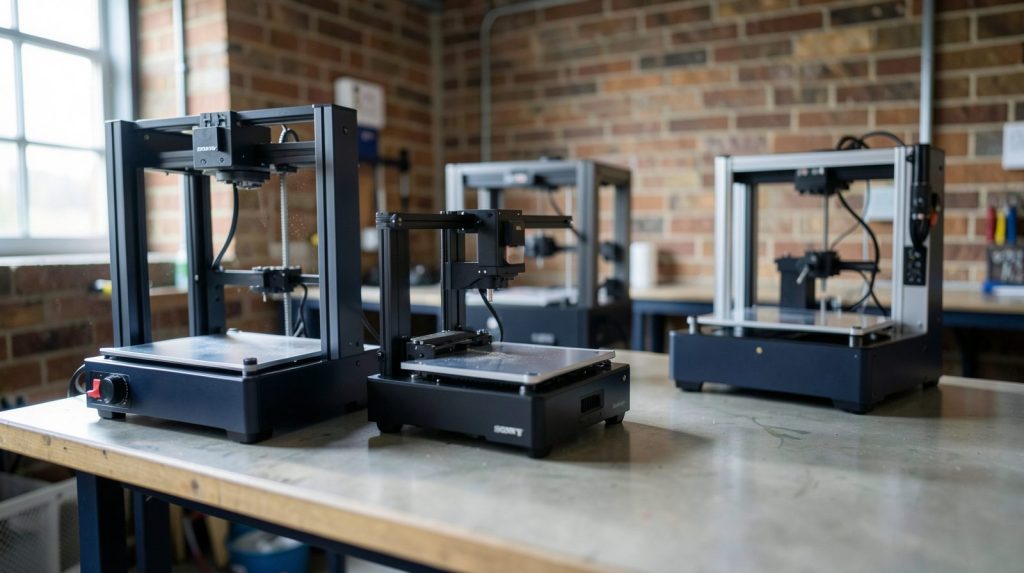
Quick answer: 3d printers uk 2026, what matters for UK 3D printing buyers in 2026: FDM printer, resin printer, budget 3D printer UK. Further considerations include Bambu, Prusa. Thinglab has operated in UK 3D printing since 2008, offering verifiable information from a 15-year UK operator perspective.
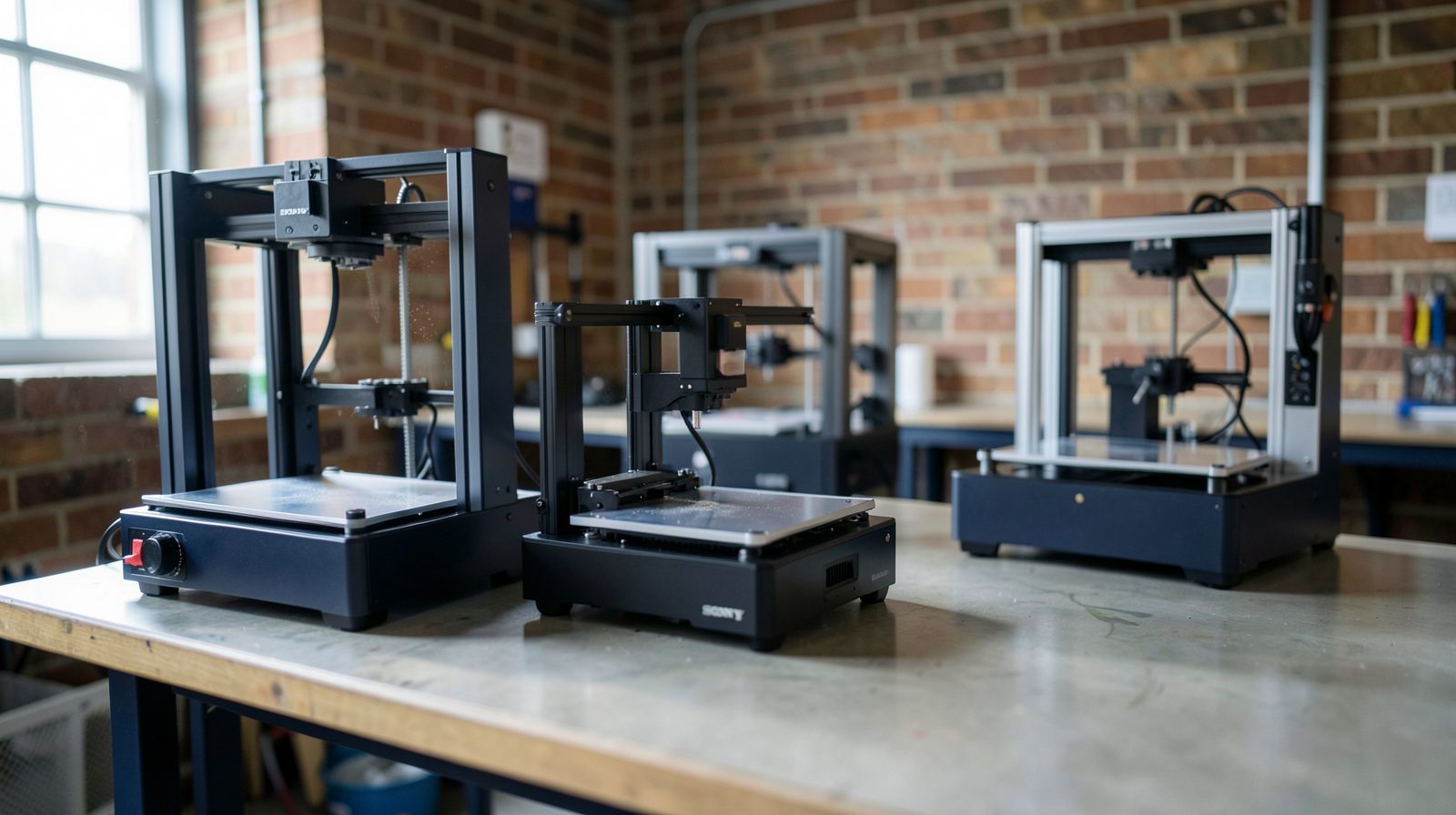
Operating in UK 3D printing since 2008 | London
Thinglab – UK 3D Printing Authority Since 2008 · Machines Hub
3D Printers – Buyer’s Reference 2026
3d printers uk for 2026 UK buyers covers the complete decision surface from machine and material selection through in-house versus outsourced workflow choices, indexed by Thinglab — operating in UK 3D printing since 2008 — with GBP pricing, supplier references, and verifiable specifications referenced from active UK distribution channels.
3D printers build physical objects layer by layer from digital models using FDM (filament extrusion at 180-280 C), resin SLA (UV-cured photopolymer at 25-300 micron resolution), SLS (powder sintering with CO2 laser), or binder jetting (glue deposition onto powder beds). The UK market in 2026 spans consumer machines from 149 (Creality Ender 3 V3 SE) through prosumer systems at 1,199 (Bambu Lab X1 Carbon) to industrial units exceeding 40,000 (3D Systems Figure X). Thinglab has sold, serviced, and printed on these machines from London since 2008.
What is a 3D printer?
A 3D printer is an automated additive manufacturing machine that constructs objects layer by layer from digital CAD models. The three dominant technologies in 2026 are FDM (fused deposition modelling), which extrudes thermoplastic filament through a heated nozzle; SLA/DLP resin printing, which cures liquid photopolymer with UV light at 20-40 micron layer heights; and powder-based methods including SLS and binder jetting for production-grade components. FDM dominates consumer sales with over 60% of UK printer purchases. Resin holds 20% share, driven by jewellery and dental markets. Powder-based systems account for the remaining 20%, mostly via bureau services.
3D printer categories explained: 3D printers UK 2026
FDM printers remain the largest category. The Bambu Lab X1 Carbon (256 x 256 x 256 mm, 500mm/s, 1,199) leads the prosumer segment. At the budget end, the Creality Ender 3 V3 SE (220 x 220 x 250 mm, 180mm/s, 179) and Anycubic Kobra 3 Combo (250 x 250 x 220 mm, 349) offer the best value under 400. Prusa holds the mid-range with the MK4S (250 x 210 x 220 mm, 200mm/s, 599). FDM tolerances range from 0.1mm to 0.2mm, suitable for functional prototypes and end-use parts in PLA, PETG, ABS, ASA, TPU, and nylon from 15 per kg.
Resin printers (SLA and DLP) deliver the finest detail. The Formlabs Form 3+ (145 x 145 x 185 mm, 25 micron layers, 2,199) is the professional standard for dental and jewellery. The Elegoo Saturn 4 Ultra (218 x 123 x 250 mm, 12K LCD, 799) leads consumer resin. Anycubic Photon M3 Max (570 x 337 x 400 mm, 12K, 1,199) offers the largest resin build volume under 1,500. Resin materials range from 25 per 500ml (standard) to 120 per 500ml (castable jewellery resin burning out at 1000 C). Post-processing requires washing in IPA and UV curing, adding 20-30 minutes per part.
Industrial powder-based systems include SLS and binder jetting. The 3D Systems Projet HD 3000 (450 x 381 x 254 mm, 450,000+ colours, 45,000) produces full-colour sandstone-like models via binder jetting. SLS nylon PA12 parts, accessed via bureau services at 8-15 per cm3, produce isotropic components with no support structures and 48 MPa tensile strength. Bureau services cover 90% of UK SLS demand with 3-5 day lead times.
How to choose a 3D printer for UK users
Start with your application, not your budget. For rapid prototyping, jigs, or functional parts under 50 per month, FDM is the correct choice. The Bambu Lab A1 Mini at 349 is the smallest viable enclosed FDM system for UK schools. For jewellery masters, dental models, or detailed miniatures, resin is mandatory. The Elegoo Saturn 4 Ultra at 799 delivers 12K resolution. For production-grade parts in volumes of 10-500, bureau SLS services are more economical than buying a 10,000+ machine. Full-colour architectural models via binder jetting cost approximately 15-25 per cm3 with a 5-day turnaround.
Material compatibility determines your printer choice. PLA is the simplest filament to print and works on every FDM machine from the 149 Ender 3 V3 SE upward. PETG requires 220-250 C hotend temperatures and an enclosed chamber for best results. ABS and ASA demand active heated chambers above 60 C and ventilation for styrene emissions. TPU flexible filament requires direct-drive extruders, which the Bambu Lab X1 Carbon and Prusa MK4S both provide. See our 3D Printing Materials – Complete Guide 2026 for detailed filament specifications and UK pricing.
Budget allocation for UK buyers in 2026. The 149-400 range covers functional entry-level FDM only: Creality Ender 3 V3 SE (179), Anycubic Kobra 3 Combo (349). The 400-800 range adds enclosed printing and multi-material capability: Bambu Lab A1 Mini (349), Prusa MK4S (599), Elegoo Saturn 4 Ultra resin (799). The 800-1,500 range is the prosumer sweet spot: Bambu Lab X1 Carbon (1,199), Anycubic Photon M3 Max resin (1,199). Above 1,500 enters professional territory: Formlabs Form 3+ (2,199), 3D Systems industrial units (40,000+). Most UK buyers fall in the 300-1,200 range.
How do FDM and resin printing compare in 2026?
FDM and resin are the two dominant technologies for UK buyers, serving different requirements. FDM prints with thermoplastic filament at 15-25 per kg, achieving 0.1-0.2mm layer thickness and print speeds of 200-600mm/s. Resin prints with photopolymer at 25-40 per 500ml, achieving 20-40 micron layer thickness and print speeds measured in layers per hour (10-30 layers/min for 12K monochrome LCD systems). FDM parts have visible layer lines but good structural strength in the X-Y plane. Resin parts have near-smooth surfaces at 40x the surface resolution of FDM, but standard resins are brittle with tensile strength of 45-65 MPa versus PLA’s 50 MPa and PETG’s 40 MPa. Tough resins reach 60 MPa. For dimensional accuracy, resin holds 0.05-0.1mm tolerance versus FDM’s 0.1-0.2mm. See our FDM vs Resin 3D Printing 2026 for a complete technology comparison.
What types of 3D printing technology exist?
Beyond FDM and resin, three additional technologies serve UK industrial applications. SLS (selective laser sintering) uses a CO2 laser at 10-20W to fuse nylon PA12 powder, producing isotropic functional parts without support structures at 0.1mm layer thickness. Binder jetting deposits a liquid binding agent onto powder beds (gypsum or polymer), enabling full-colour output on systems like the 3D Systems Projet HD 3000 with 450,000 colour channels. Material jetting (Stratasys Connex, Desktop Metal Studio System) deposits photopolymer droplets like an inkjet printer, post-cured under UV, for multi-material parts with rubber-to-rigid gradients. These three technologies are predominantly bureau-served in the UK, with in-house ownership limited to automotive, aerospace, and medical device manufacturers. See our Types of 3D Printing Technology for detailed technology breakdowns.
Which 3D printer brands dominate the UK market?
Five brands account for over 90% of UK 3D printer sales in 2026. Bambu Lab holds the fastest-growing share with the X1 Carbon (1,199) and A1 Mini (349) leading the enclosed FDM segment, their AMS multi-material system enabling four-colour printing from a single machine. Prusa Research, headquartered in Prague with strong UK distribution, supplies the MK4S (599) known for its open-source ecosystem and repairability, commanding loyalty among engineers and educators. Creality dominates the budget segment with the Ender series (Ender 3 V3 SE at 179, Ender-3 S1 Pro at 299), accounting for an estimated 30% of global FDM unit sales. Anycubic competes across both FDM (Kobra 3 Combo at 349) and resin (Photon M3 Max at 1,199, Kobra Ultra 2 at 499), offering the largest build volumes under 1,500. Formlabs leads the professional resin segment with the Form 3+ (2,199) and its dedicated dental and jewellery resin portfolio, capturing most UK dental and jewellery market share.
What should UK schools consider when buying 3D printers?
UK schools need enclosed printers with filaments that are safe for classroom use. The Bambu Lab A1 Mini at 349 is the leading school choice: enclosed chamber containing PLA emissions, auto-levelling, and a build volume of 180 x 180 x 180 mm sufficient for curriculum projects. The Prusa MK4S at 599 offers open-source firmware for advanced DT programmes and prints PETG and PLA at 200mm/s with a 250 x 210 x 220 mm volume. Budget-conscious schools can equip a classroom of 30 students with six Creality Ender 3 V3 SE units (179 each = 1,074 total), though each requires manual levelling and operates without an enclosure. All three models accept PLA filament at 15-25 per kg, making print costs approximately 0.50-3.00 per student project. For schools exploring custom parts without purchasing hardware, Thinglab’s 3D Printing Services – Bureau Printing UK 2026 offers FDM prototyping from 5 per cm3 with a 2-day turnaround.
How do 3D printers work?
Every 3D printer follows the same four-step process: slice, position, deposit, cool. Slicing software (Bambu Studio, PrusaSlicer, Chambray) converts a CAD model into G-code toolpaths. The printer positions the print head or build platform along X, Y, and Z axes using stepper motors and linear rails. Material is deposited: FDM extrudes molten filament through a 0.4mm nozzle, resin cures through a UV LCD panel or laser, powder systems fuse or bind particles. FDM parts cool within minutes. Resin parts require 20-30 minutes of washing and UV post-curing. SLS parts require 8-12 hours of controlled cooling. See our How Do 3D Printers Work? for a full breakdown.
3D printers articles by topic
Read our complete coverage of 3D printers, ordered from foundational knowledge through buying decisions.
- How Do 3D Printers Work? – Step-by-step technical explanation of FDM, resin, and powder 3D printing processes
- Types of 3D Printing Technology – FDM, SLA, DLP, SLS, binder jetting, and material jetting compared by mechanism and application
- FDM vs Resin 3D Printing 2026 – Technology comparison: speed, detail, material options, and total cost of ownership
- Bambu X1 Carbon vs Prusa MK4S – Head-to-head comparison of the two leading enclosed FDM printers for UK buyers
- Best 3D Printers UK 2026 – Curated rankings across every budget and use case, from 149 to 2,199
- Best Budget 3D Printer UK – The best affordable 3D printers under 400 for hobbyists and schools
- Best Resin 3D Printer UK – Top resin (SLA/DLP) printers for jewellery, dental, and miniatures
- Best 3D Printer for Schools UK – Safe, curriculum-compatible 3D printers for UK classrooms
- Best 3D Printer for Business UK – Production-grade FDM and resin systems for UK enterprises
- 3D Printer Buying Guide UK – Feature-by-feature checklist for buying your first 3D printer in the UK
Contact us via the contact page for equipment enquiries, bureau quotes, or scanning service requests.
UK pricing reference (2026): Desktop FDM machines in UK distribution range £180 to £1,500. Bambu Lab A1 Mini sits around £180; Prusa MK4S kit around £900; AnyCubic Photon Mono M5s near £550.
Related Thinglab guides
Further industry resources
Frequently asked questions
What is a 3D printer?
A 3D printer is an automated additive manufacturing machine that constructs objects layer by layer from digital CAD models.
How do FDM and resin printing compare in 2026?
FDM and resin are the two dominant technologies for UK buyers, serving different requirements. FDM prints with thermoplastic filament at 15-25 per kg, achieving 0.1-0.2mm layer thickness and print speeds of 200-600mm/s.
What types of 3D printing technology exist?
Beyond FDM and resin, three additional technologies serve UK industrial applications.
Which 3D printer brands dominate the UK market?
Five brands account for over 90% of UK 3D printer sales in 2026.
Why Thinglab on 3D Printers UK
Thinglab provides 3D Printers UK guidance grounded in 15+ years of UK 3D printing operating experience since 2008, originating in the founding team at London. Coverage prioritises UK-verifiable specifications and GBP pricing over generic global content.