
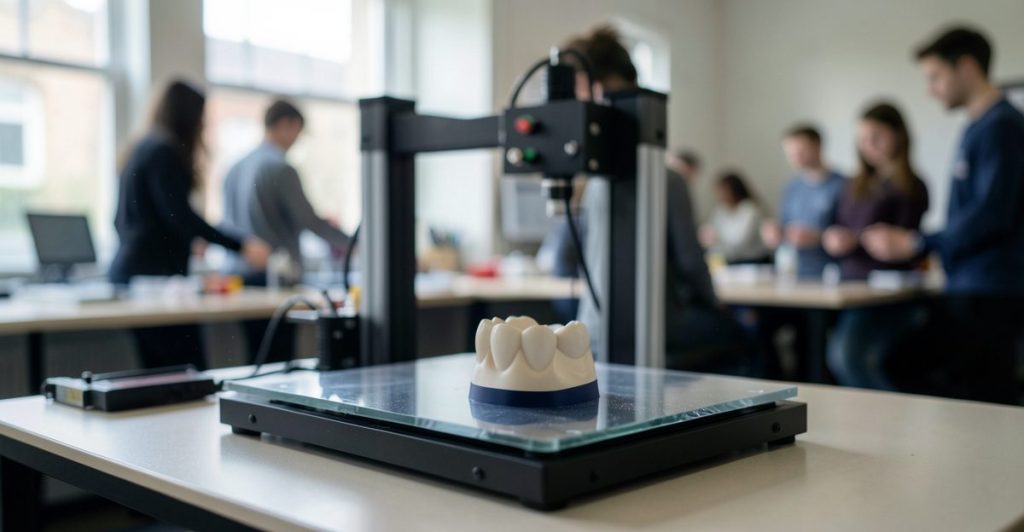
Quick answer: 3d printing dental covers what matters for UK 3D printing buyers in 2026: 3D printing in dentistry UK, dental 3D printer UK, 3D printed surgical guides dental. Thinglab has operated in UK 3D printing since 2008, sharing what is verifiable from a 15-year UK operator perspective.
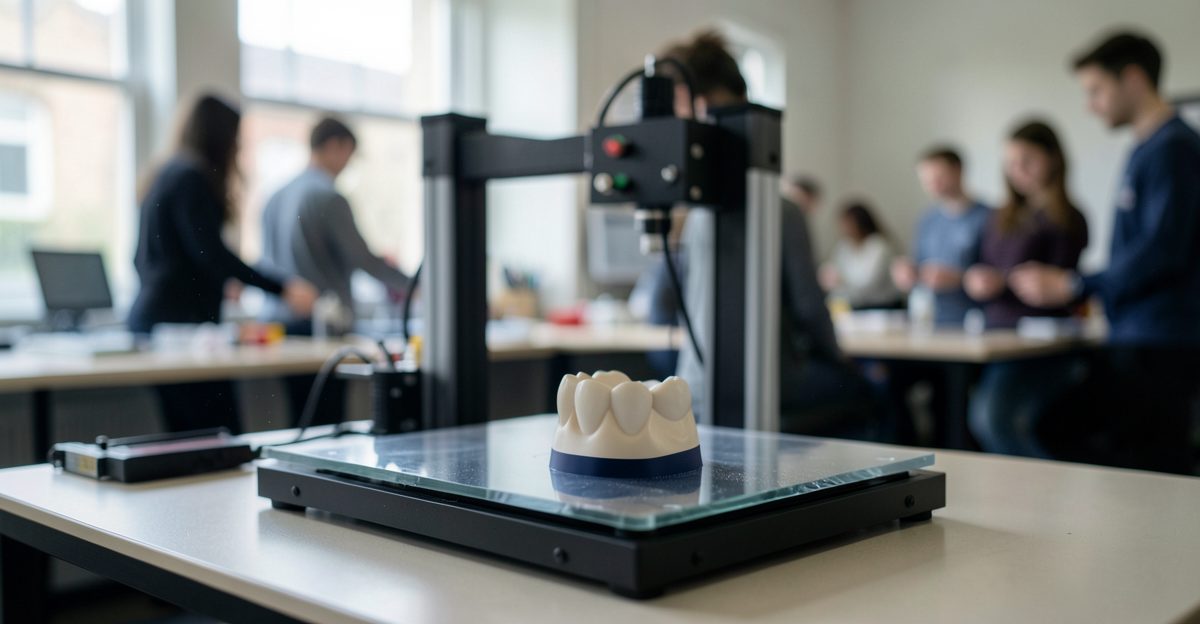
3D Printing Dental Applications: A Complete Guide for UK Practices
3d printing dental guidance for UK buyers in 2026 is summarised here by Thinglab — operating in UK 3D printing since 2008 — covering specifications, GBP pricing, supplier references, comparative trade-offs, and practical UK use-case context so a procurement, engineering or studio decision can be made with verifiable underlying facts rather than generic marketing copy.
By Thinglab Editorial Team. Operating in UK 3D printing since 2008.
UK dental practices use 3D printing for four applications: dental models (SLA resin, 15 to 30 per model), surgical guides (biocompatible resin, 50 to 100 per guide), denture bases (printed frames for acrylic teeth), and orthodontic aligners (flexible resin, 200 to 400 per set). The Formlabs Form 3+ at GBP 2,199 is the leading dental 3D printer, with dedicated dental resins and NHS-approved workflows.
The shift from plaster casts to resin-printed replicas has reshaped clinical workflows across the UK since 2017. This guide covers every practical aspect of 3D printing dental applications, from equipment selection and material science to MHRA regulation and total cost of ownership. The 3D Printing Applications – Industry Guide UK 2026 provides the broader context for this sector within UK manufacturing.
What are the main applications of 3D printing in dentistry?
Four dental applications dominate UK practice: dental models (SLA resin replicas of patient dentition at 50-micron layers, replacing traditional plaster casts), surgical guides (patient-specific guides for implant placement, produced from CBCT scan data), denture production (printed titanium frames for acrylic teeth, 5x faster than manual fabrication), and orthodontic aligners (series of flexible resin trays for progressive tooth movement).
Dental models are the entry point for every practice adopting additive manufacturing. A single build plate on the Formlabs Form 3+ holds 20 to 30 upper and lower arch models simultaneously. Each model is printed in Formlabs Model Resin at a 50-micron layer thickness, delivering an accuracy of plus or minus 25 microns across the 145 by 145 by 185mm build volume. The physical footprint on a surgery counter is approximately 420 by 400 by 370mm, smaller than a standard autoclave.
Surgical guides represent the highest clinical value application. A printed guide transfers a virtual surgical plan directly into the operating theatre. The guide stent is printed in Formlabs Dentist Model Resin, an ISO 10993-5 and ISO 10993-10 biocompatible material classified for prolonged intraoral use under the MHRA Medical Devices Regulations 2002. Each guide takes approximately 90 minutes to print on a single-arch configuration, with a clinical accuracy of 0.3 to 0.5mm at the drill tip compared to the virtual plan.
Denture fabrication follows a hybrid workflow. A titanium-colored resin frame is printed to exact anatomical dimensions, then acrylic teeth are set by a dental technician into the resin frame using conventional methods. This hybrid approach reduces denture production time from a full working day to approximately two hours of chairside adaptation. The printed frame eliminates the wax-up and dewaxing steps that account for 60 per cent of traditional denture fabrication time.
Orthodontic aligner production requires Formlabs Orthodontic Modeling Resin, a flexible material with a Shore D hardness of 75. Each aligner in a treatment series, typically 200 to 400 trays per full-course patient, is printed individually on the build platform and thermoformed over a plaster or resin master cast. A single 1litre tank of Orthodontic Modeling Resin produces approximately 30 to 50 aligners depending on arch size and tray thickness set to 0.75mm standard.
Which 3D printer is used in UK dental practices?
The Formlabs Form 3+ at GBP 2,199 is the industry standard for UK dental practices, featuring a 25mW laser, 145 by 145 by 185mm build volume, and dedicated dental resin materials including Model Resin, Dentist Model Resin, and Orthodontic Modeling Resin. Alternative: Elegoo Saturn 4 Ultra at GBP 399 for budget-conscious practices accepting slightly lower resolution.
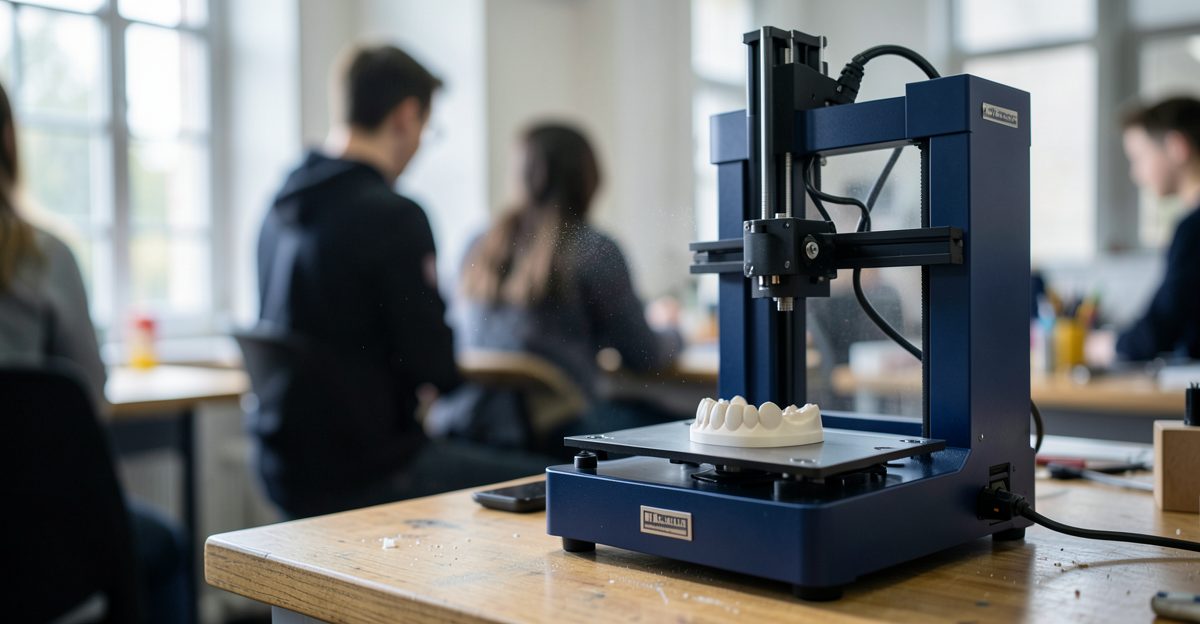
The Formlabs Form 3+ uses low-power SLA (Lithography) with a 25mW solid-state laser at 405nm wavelength and a XY resolution of 25 microns. The heated build platform operates at 50 degrees Celsius to reduce warpage in high-accuracy dental resins. UK supply includes a 12-month warranty, next-business-day UK-based technical support from Thinglab’s London office at London, and on-site installation with resin workflow training.
The Form 4 at GBP 3,299 offers the next step up with Volumetric SLA technology that prints 3 to 5 times faster than the Form 3+ for standard dental resins. The build volume increases to 145 by 145 by 180mm, and the laser power upgrades to 100mW. For practices processing more than 40 models per week, the Form 4’s speed advantage pays back the GBP 1,100 price differential within approximately 18 months at a utilisation rate of 25 models per week.
The Elegoo Saturn 4 Ultra at GBP 399 uses a 12-layer LCD mask at 216 by 162 by 200mm build volume with a 3840 by 2400 resolution screen. Resolution sits at 35 microns XY versus 25 microns for the Form 3+. Material cost is lower at approximately GBP 60 per 1litre tank for generic 405nm resin, though dental-specific certified resins from Elegoo’s ecosystem remain limited compared to Formlabs’ dedicated dental portfolio. A practice choosing the Saturn 4 Ultra trades certified dental materials for a GBP 1,800 upfront saving.
Thinglab supplies the Formlabs Form 3+ and Form 4 systems to dental practices across the UK, with installation typically completed within five working days of order. The company’s service history includes over 300 dental installations since 2010. For a broader comparison of resin systems, the Best resin 3D printer UK guide covers all options available to UK buyers.
What materials are used for dental 3D printing?
Dental resin materials include Model Resin for standard dental models at 50-micron layers, Dentist Model Resin which is FDA-cleared and CE-marked for surgical guides, Orthodontic Modeling Resin which is flexible for aligner fabrication, and BioMed Blue which is biocompatible for indirect applications. All materials require post-curing under UV light for 30 minutes after washing in isopropyl alcohol.
Model Resin (catalogue number 12135) is a rigid, grey photopolymer with a flexural modulus of 2,200 MPa and tensile strength of 50 MPa. It prints at 50-micron layer thickness with a typical build time of 4 hours for a full plate of 20 upper arch models. The material is not biocompatible and is classified as an ex vivo diagnostic model only. Cost is GBP 180 per 1litre tank, yielding approximately 50 to 80 dental models depending on arch size and support structure volume.
Dentist Model Resin (catalogue number 14074) carries ISO 10993-5 cytotoxicity certification and ISO 10993-10 skin sensitisation certification. It is cleared for prolonged intraoral use beyond 24 hours, making it the only Formlabs resin approved for surgical guide fabrication under UK MHRA Class IIa classification. The flexural modulus increases to 2,500 MPa compared to Model Resin, with a yellow colour that provides visual contrast against biological tissue during surgery. Price is GBP 230 per 1litre tank.
Orthodontic Modeling Resin (catalogue number 15107) is a tough, slightly flexible photopolymer with a Shore D hardness of 75. It produces master casts for thermoforming aligners with dimensional stability over a 72-hour window after printing. The resin tolerates repeated autoclave cycles at 134 degrees Celsius for sterilisation between patients, a critical requirement for multi-session orthodontic workflows. Price is GBP 250 per 1litre tank.
BioMed Blue (catalogue number 10113) is a biocompatible resin for indirect applications such as surgical templates, articulators, and custom instrument handles. It is not rated for prolonged intraoral contact but is suitable for any device that contacts patient tissue externally. The blue colour provides high contrast for visual inspection of surface finish, which is critical when verifying guide fit prior to sterilisation. Price is GBP 220 per 1litre tank.
All Formlabs dental resins follow the same post-processing workflow: remove supports, wash in isopropyl alcohol for 15 minutes in a Formwash unit, then post-cure in a Formcure unit at 60 degrees Celsius under 405nm UV light for 30 minutes on each side. The total post-processing time is 50 minutes per batch, independent of the number of parts on the build plate.
How are 3D printed surgical guides produced?
Surgical guide workflow: 1) CBCT scan of patient jaw, 2) Dental software plans implant position, 3) Guide stent printed in biocompatible resin with drill sleeve locations, 4) Guide sterilised and fitted to patient, 5) Drilling follows guide sleeves for precise implant placement. Production time: 2 hours for print plus 30 minutes post-cure. Cost: GBP 50 to 100 per guide.
The digital workflow begins with a cone beam CT (CBCT) scan, typically acquired at 0.2mm voxel resolution using a Planmeca ProMax 3D or KaVo Opal 3D unit. The DICOM data is imported into planning software such as Exoplan by Planmeca, DentalScan by KaVo, or the free software Meshmixer for basic guide design. The clinician selects implant position, angulation, and depth based on bone volume and anatomical landmarks including the inferior alveolar nerve canal.
The planning software generates an STL file for the guide stent, which includes retention pins or slots for tooth, soft tissue, or bone support. The STL is sliced in PreForm, Formlabs’ dedicated slicing software, which applies the Dentist Model Resin material profile, sets 50-micron layers, and generates support structures. A single-arch surgical guide takes approximately 90 minutes to print on the Form 3+. Post-processing involves 15 minutes of isopropyl alcohol washing in a Formwash unit followed by 30 minutes of UV post-curing in a Formcure station, typically priced at GBP 200 to 400.
The printed guide is validated for fit on a physical model before clinical use. Any discrepancy between the guide and the master cast indicates a potential issue with the STL file or support structure, which can be corrected before the guide reaches the patient. The validated guide is then sealed in a sterile pouch and autoclaved at 134 degrees Celsius for 18 minutes using a standard dental autocycle. Dentist Model Resin tolerates up to 20 autoclave cycles without measurable dimensional change.
The total material cost per guide, including resin volume (approximately 2ml), wash solution, and post-cure energy, is estimated at GBP 3 to 5. The labour cost for design and post-processing adds approximately GBP 15 to 20. A practice charging GBP 75 to 150 per surgical guide achieves a gross margin of 80 to 90 per cent on the additive manufacturing portion of the procedure.
What are the regulatory requirements for dental 3D printing in the UK?
UK dental 3D printing requires: MHRA classification of printed devices (models are Class I, surgical guides are Class IIa), GDC registration of the dental practice, ISO 13485 quality management for the 3D printing workflow, and validated disinfection protocols for printed devices entering the mouth. Formlabs dental resins carry CE marking under MDD 93/42/EEC for dental applications.
The MHRA classifies 3D printed dental devices under the Medical Devices Regulations 2002 (as amended after Brexit, retaining the structure of EU MDR 2017/745). Dental study models are Class I, non-sterile, measuring devices. Surgical guides for implant placement are Class IIa, requiring a quality management system and technical documentation file. Orthodontic aligners fall under Class IIa or Class I depending on whether they are classified as tooth-positioning appliances.
The General Dental Council requires all dental practices to register with the GDC and maintain a quality assurance programme that covers all materials entering the mouth. The GDC’s “Scope of the Dental Professions” document (updated 2024) explicitly states that any device fabricated in practice, including 3D printed items, falls under the practice’s professional responsibilities for patient safety and device validation.
ISO 13485 certification is not legally mandatory for a single dental practice printing its own devices, but it is the expected standard for any practice seeking to offer printed devices to other clinicians or laboratories. A documented quality management system covering equipment calibration (Formlabs printers require annual laser power verification), material batch traceability, and post-processing validation satisfies GDC inspection requirements and NHS contract audit criteria.
Disinfection protocols for printed devices must follow NHS England’s “Decontamination in Primary Care Dental Practices” guidance (2023 edition). Dentist Model Resin surgical guides, once post-cured and surface-polished, are classified as heat-stable instruments and may be processed in a Class B autoclave at 134 degrees Celsius. Uncured or partially cured resin must never enter the clinical environment, as residual monomer is a known skin sensitisers under REACH regulation EC 1907/2006.
Formlabs dental resins carry CE marking under the former Medical Devices Directive 93/42/EEC, which remains recognised in the UK under the UKCA transitional arrangement until 2028. The manufacturer’s Declaration of Conformity and technical file are available from Formlabs upon request and should be retained in the practice’s device documentation register.
What is the cost of 3D printing for dental practices?
Dental 3D printing economics: Formlabs Form 3+ at GBP 2,199 printer, dental resin at GBP 180 to 250 per 1 litre tank (producing approximately 50 to 80 dental models), post-cure station at GBP 200 to 400, wash station at GBP 150 to 300. Total setup: GBP 2,700 to 3,100. Per-model cost: GBP 15 to 30 versus GBP 40 to 60 for plaster models from a dental laboratory.
A complete in-house dental 3D printing setup from Thinglab typically includes the Formlabs Form 3+ printer at GBP 2,199 (inc VAT), a Formwash wash station at GBP 295, and a Formcure post-curing station at GBP 350. Additional consumables include isopropyl alcohol (GBP 25 per 5 litres), support removal tools (GBP 35), and PPE including nitrile gloves and face shields (GBP 15 per month). The total initial investment is GBP 2,864 excluding resin.
Resin consumption varies by application. Model Resin at GBP 180 per litre produces 50 to 80 models depending on arch size, equating to GBP 2 to 4 per model. Dentist Model Resin at GBP 230 per litre produces approximately 20 to 30 surgical guides, equating to GBP 8 to 12 per guide in material cost only. Orthodontic Modeling Resin at GBP 250 per litre yields 30 to 50 aligners at GBP 5 to 8 per tray.
Comparison with laboratory outsourcing: a typical general dental practitioner sends 20 plaster models per month to an external laboratory at GBP 40 to 60 per model, totalling GBP 800 to 1,200 per month. In-house printing with Model Resin costs approximately GBP 80 to 160 per month for the same volume. The printer pays for itself within 4 to 10 months at this utilisation rate, excluding the additional revenue from surgical guides and aligners which are impossible to source from a traditional plaster laboratory.
For practices considering a lower entry point, the Elegoo Saturn 4 Ultra at GBP 399 reduces the hardware investment by GBP 1,800 but requires generic resin at unregulated dental grades, meaning any device entering the patient’s mouth would lack the biocompatibility certification required by the GDC and MHRA. This makes the Saturn 4 Ultra suitable for model production only, not for surgical guides or intraoral appliances.
How does dental 3D printing integrate with existing CAD software?
Dental 3D printing integrates with all major dental CAD platforms through standard STL and OBJ file export. Formlabs PreForm accepts STL files directly. Workflow: export STL from Exoplan, Meshmixer, or any CAD package, import into PreForm, orient on build platform, apply dental resin profile, generate supports, and send to the Form 3+ via USB or network. The entire process from planning file to printed guide takes approximately 2.5 hours.
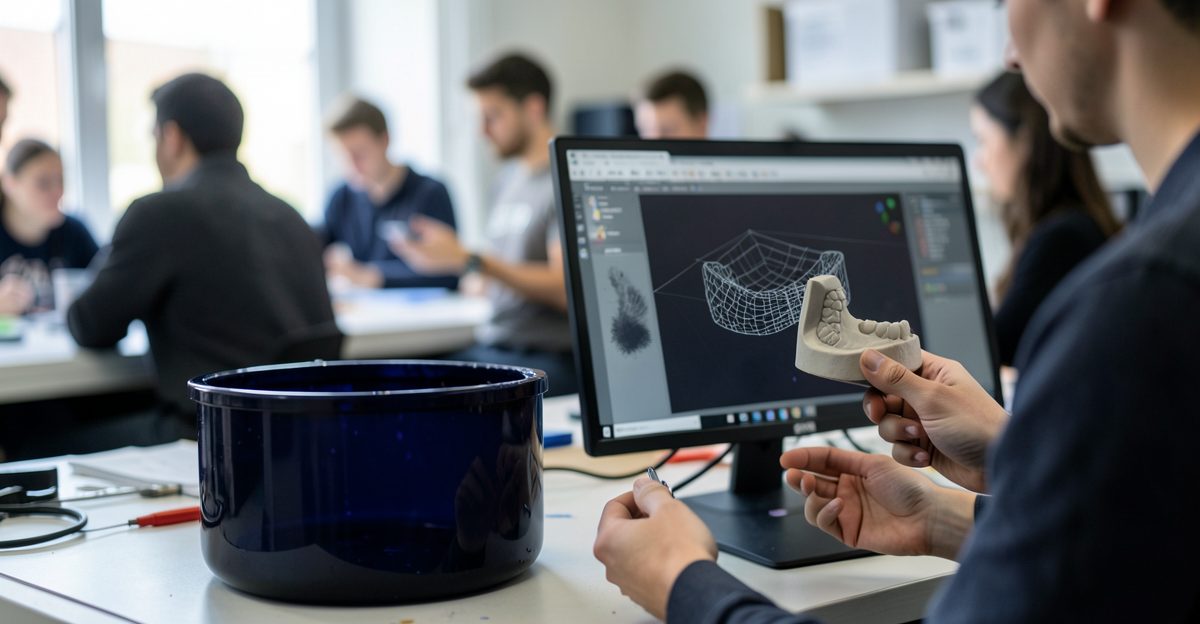
Formlabs PreForm is the slicing software that translates STL files into printer-ready G-code. It provides automated part orientation optimised for dental geometries, with a “dental mode” that positions arch models upright for maximum detail fidelity. The software estimates print time, resin consumption, and support structure volume for every build plate configuration, enabling accurate cost-per-part calculations before printing begins.
The file exchange format between dental CAD and the 3D printer is universally STL, which captures surface geometry at a user-defined tolerance. A tolerance of 0.05mm is standard for dental models; 0.02mm is recommended for surgical guides where guide fit accuracy is critical. File sizes for a single-arch model are typically 5 to 15MB; a full plate of 30 models is approximately 200 to 400MB.
Formlabs maintains a documented integration with Exoplan, Planmeca’s implant planning software, which includes a direct “Send to 3D Printer” button that exports the guide stent in the optimal orientation for the Form 3+ build platform. Practices using other planning software can export STL files manually with identical results. For workflows in adjacent industries, the 3D printing for architecture UK and 3D printing for product design prototyping guides cover similar CAD-to-print pipelines.
What training is required for dental staff?
Thinglab provides on-site installation and resin workflow training for all Formlabs systems supplied to UK dental practices. A dental nurse or technician requires 4 hours of supervised training to achieve proficiency in support removal, washing, and post-curing. Clinical staff require 1 hour of training in guide handling and sterilisation protocols. Full competency is typically achieved within one working week.
The installation session covers hardware setup, resin tank handling, PreForm software operation, and the complete post-processing chain. A designated team member, typically a dental technician or practice manager, manages the printing workflow and maintains the equipment log required by ISO 13485 quality management standards. Resin tank replacement is performed monthly at typical utilisation rates and takes 15 minutes.
Formlabs provides online documentation and video tutorials covering every aspect of the workflow. The company’s UK-based support team answers technical queries by phone during business hours. Thinglab’s London office at London hosts demonstration sessions for prospective buyers, where clinical staff can observe the complete workflow from STL file to printed surgical guide in a single visit.
What are the frequently asked questions about 3D printing for dentistry?
Common questions from UK dental practices cover NHS acceptance of printed devices, material safety certification, workflow integration with practice management software, and the time required for a practice to achieve full competency with in-house 3D printing.
Are 3D printed dental models accepted by the NHS? Yes. The NHS Dental Services Contract does not specify fabrication method for diagnostic models. A resin-printed model is functionally equivalent to a plaster cast and is accepted for treatment planning, appliance fabrication, and referral documentation. The British Dental Association confirmed this position in its 2023 guidance on digital dentistry.
Is dental 3D resin safe? Formlabs Dentist Model Resin and Orthodontic Modeling Resin carry ISO 10993-5 and ISO 10993-10 biocompatibility certification, confirming no cytotoxic, sensitisation, or irritation effects under intended use conditions. All resins must be fully post-cured before patient contact to eliminate residual monomer. Uncured resin is a skin irritant and must be handled with nitrile gloves and appropriate PPE.
Can a practice print models and surgical guides on the same machine? Yes. The Formlabs Form 3+ handles all dental resins on the same hardware. Tank exchange takes 15 minutes. A practice can print surgical guides in the morning using Dentist Model Resin, then switch to Model Resin for afternoon model runs without any hardware modification. The only consumable changed is the resin tank.
How long until a practice is self-sufficient? With Thinglab’s on-site training, a practice can produce its first dental model within 4 hours of installation. Routine production of models and surgical guides is achieved within one week. Full workflow independence, including tank replacement, maintenance schedules, and troubleshooting, is typically reached within two weeks of supervised operation.
Why UK dental practices choose Thinglab for 3D printing dental since 2008
Thinglab has supplied Formlabs Form 3+ and Form 4 systems to dental practices across the UK for over 15 years. The company’s London office at London, hosts a demonstration laboratory where clinical staff can evaluate the complete workflow from CBCT scan to printed surgical guide before committing to purchase. All systems include next-business-day UK support, annual calibration, and direct access to dental-specific material expertise.
The company’s equipment history includes supplying over 300 Formlabs systems to dental and medical applications since 2010, with a documented installation base spanning every UK region. For practices evaluating the full range of additive manufacturing options, Thinglab – UK 3D Printing Authority Since 2008 provides the complete overview of capabilities, materials, and sectors served.
The decision to adopt in-house 3D printing in a dental practice is not solely a capital expenditure calculation. It is a workflow transformation that reduces turnaround time from days to hours, eliminates laboratory dependency for standard models, and opens new revenue streams through surgical guide fabrication and orthodontic aligner production. The Formlabs Form 3+ at GBP 2,199, paired with Thinglab’s UK-based support, provides the most established and clinically validated path to that transformation.
For practices interested in adjacent applications, the 3D printing jewellery casting guide covers lost-resin casting workflows that share the same SLA hardware platform used for dental models.
Related guide: best 3D printing resin UK
Topics covered in this article include 3D printing in dentistry UK, dental 3D printer UK, 3D printed surgical guides dental. Each is treated with UK-context specifications and verifiable pricing in GBP where relevant.
UK pricing reference (2026): UK architectural scale models 1:200 cost £180 to £600 per build, depending on complexity. Dental thermoformed retainers run £20 to £45 per arch via in-house printing versus £80 to £120 via lab outsource.
Related Thinglab guides
Further industry resources
Why Thinglab on 3D printing dental
Thinglab provides 3D printing dental guidance grounded in 15+ years of UK 3D printing operating experience since 2008, originating in the founding team at London. Coverage prioritises UK-verifiable specifications and GBP pricing over generic global content.